Johor Bahru visitors, meanwhile, are projected to increase their spending in Singapore by S$756 million annually, Xinhua News Agency reported, citing a study released on Thursday by the Singapore Business Federation (SBF), the Restaurant Association of Singapore, and the Singapore Retailers Association.
Currently, about 19.4 million annual round trips are made from Singapore to Johor Bahru, and 5.9 million in the opposite direction, using existing modes of transport, according to the study.
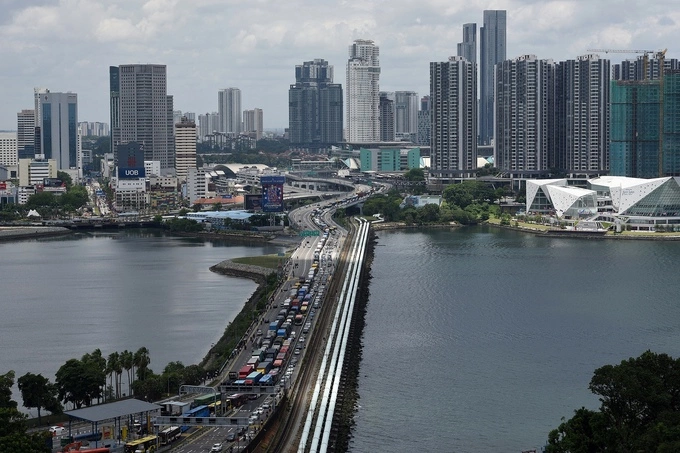 |
Vehicles form a long queue to enter Woodlands checkpoint in Singapore on March 17, 2020 from across the causeway of the southern Malaysian state of Johor. Photo by AFP |
Once operational, the Johor Bahru-Singapore Rapid Transit System Link is expected to generate an additional 11.2 million annual round trips from Singapore to Johor Bahru and 3.3 million from Johor Bahru to Singapore, equivalent to an estimated daily ridership of 39,700 passengers.
The study also noted that the RTS Link could intensify competition for Singapore’s retail and food-and-beverage sectors, which are already facing manpower shortages, rising costs and higher rents.
SBF CEO Kok Ping Soon said the shift is structural rather than incremental. He added that businesses must adapt by going beyond price competition, strengthening their product offerings, customer experience and productivity, while the government and industry should work together to help them compete in a more connected cross-border market.
Singapore and neighboring Johor Bahru have close socio-economic ties, but congestion frequently occurs at the land crossings linking the two sides, especially during peak hours and public holidays.
Sourcee.vnexpress.net