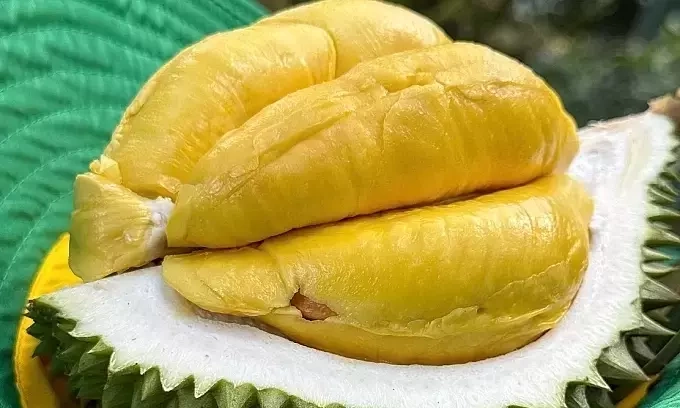
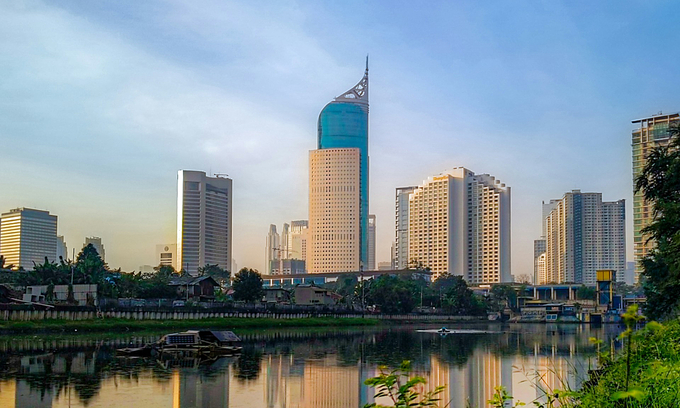
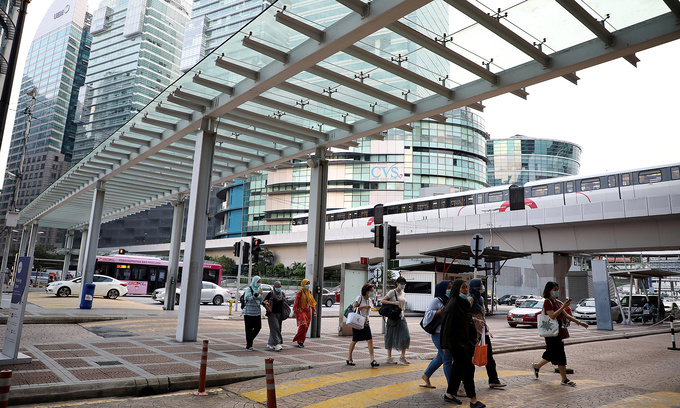
The country is in talks with the Thai government and China’s General Administration of Customs (GACC) to establish an overland route for exporting locally grown durians to China, according to Malay Mail.
Agriculture and Food Security Minister Datuk Seri Mohamad Sabu said the initiative is part of the government’s efforts to support durian growers, particularly amid a current glut following the durian season, which has occurred simultaneously in several states.
The Federal Agricultural Marketing Authority expects to purchase 1,000 tonnes of durians worth RM7 million (S$2.2 million) by the end of the current peak season in August to help absorb excess supply, The Star reported.
 |
|
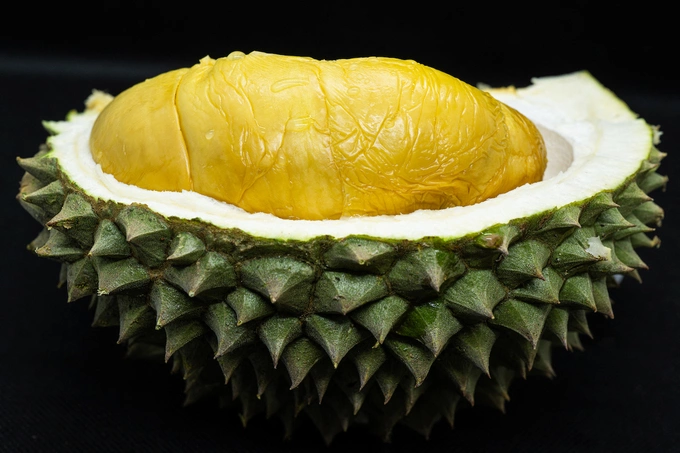
This photo taken on June 30, 2026 shows a peeled Black Thorn durian fruit in Karak, in Malaysia’s Pahang state. Photo by AFP |
The initiative comes as Malaysia’s durian industry faces mounting pressure, with production outstripping existing export capacity, causing retail prices to plunge.
The sector is going through its most challenging seasons in years, as output has surged with more orchards reaching maturity.
With only about 40 tonnes of fresh durians currently flown to China each day, officials believe a lower-cost overland route could accommodate larger shipment volumes and help relieve the domestic oversupply.
If approved, overland shipments of fresh durians could significantly increase export volumes while cutting logistics costs by up to 40%, a Malaysian official familiar with the matter told The Straits Times.
“This is one of the steps that we can take to overcome the glut issue,” the official said, speaking on condition of anonymity because the proposal has not yet been approved.
The Agriculture Department is also collaborating with the Malaysian Agricultural Research and Development Institute to study exports of “pre-cut” harvested durians, which are better suited to withstand the longer overland journey.
The method involves harvesting durians by cutting them from the stem before they fully ripen instead of waiting for them to fall naturally.
Any proposal would require approval from Chinese regulators, the department said in a July 2 statement.
A one-tonne trial shipment of Black Thorn durians was conducted in January via the proposed overland route. The shipment traveled from Malaysia’s Bukit Kayu Hitam border crossing through Thailand before reaching China in about 75 hours. By comparison, air shipments reach cargo hubs in China in roughly four hours.
Malaysia sent its first shipment of fresh durians to China in August 2024, two months after both countries signed an agreement expanding trade from durian products and frozen whole durians to include fresh fruit.
The Southeast Asian nation is aiming to capitalize on China’s multibillion-dollar durian market, where Thailand and Vietnam currently dominate fresh durian exports.
Data from China’s General Administration of Customs shows the country’s fresh durian imports surged 294% year over year to 156,000 tonnes in the first quarter of 2026, with Thailand and Vietnam supplying the overwhelming majority.
Malaysia produces more than 550,000 tonnes of durians annually. Rapid expansion of durian cultivation, combined with modern farming techniques that have shortened tree maturation from eight to 10 years to about four years, has contributed to the current oversupply.
A bumper harvest in 2026, driven by orchards planted during the previous decade’s durian boom reaching maturity, has flooded the domestic market, sending prices sharply lower and making the fruit widely affordable.
Prices have fallen by about half from 2025 levels. Black Thorn durians now sell for around RM20 per kg, while kampung durians are priced at RM7 to RM10 per kg.
At one point, durians sold for less than RM1 each, giving consumers an unprecedented opportunity to enjoy Southeast Asia’s “king of fruits.”
Sourcee.vnexpress.net