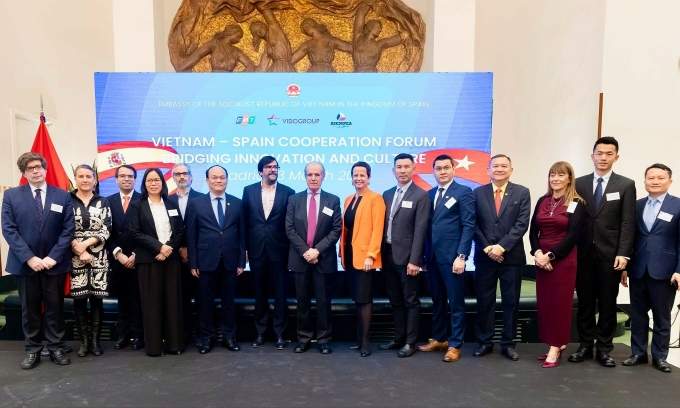
The forum brought together stakeholders from government agencies, international organizations, business associations, enterprises and universities from both countries. Participants represented sectors including aviation, hospitality, travel technology, digital transformation, healthcare and renewable energy.
In addition to business discussions, the forum also highlighted cultural connections between Vietnam and Spain, including shared traditions, cuisine and people-to-people exchanges as a basis for longer-term cooperation.
 |
|
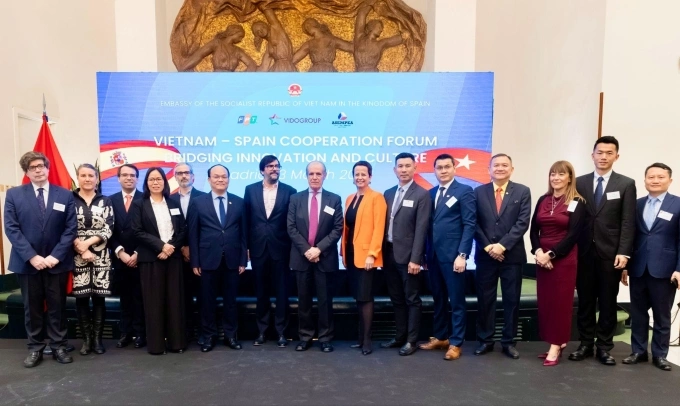
The Vietnam-Spain Cooperation Forum brought together a diverse group of stakeholders, from government officials, international organizations, and business associations. Photo courtesy of FPT |
Strengthening bilateral ties
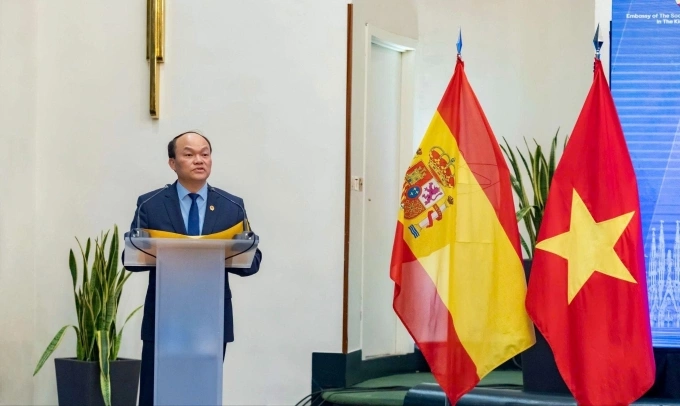
In his opening remarks, Ambassador Doan Thanh Song said the event took place amid deepening bilateral relations and expanding economic links between the two countries. He noted Vietnam’s development into one of Southeast Asia’s more open economies, supported by nearly four decades of reform and a population of more than 100 million.
He also pointed to the country’s digital economy, which has been growing at around 28% annually, and identified technology, digital transformation, tourism and cultural exchange as areas for further cooperation. He emphasized the role of business-to-business partnerships in translating diplomatic progress into concrete outcomes.
 |
|
H.E. Doan Thanh Song, Ambassador of Vietnam to Spain, speaking at the forum. Photo courtesy of FPT |
Juan Luis Jimeno, General Director of Economic and Commercial Intelligence at Spain’s Ministry of Economy, Trade and Business, said Vietnam has become Spain’s largest trading partner in ASEAN, with bilateral trade reaching €6.4 billion (US$7.35 billion) last year.
He added that more than 60 Spanish companies are operating in Vietnam across sectors such as tourism, infrastructure, energy and technology. Nearly 100,000 Spanish visitors traveled to Vietnam in 2025, while the country’s rise in the UN E-Government Development Index was cited as an indicator of growing confidence among investors.
Tourism as a bridge
Tourism was discussed as both an economic sector and a channel for cultural exchange. Participants included Vietnamese companies such as VidoGroup and Vietnam Airlines, as well as European travel and technology firms including Amadeus and Meliá, alongside Spanish travel groups Barceló and Viajes El Corte Inglés.
Speakers noted that Vietnam’s tourism appeal is increasingly linked to its “living culture,” where daily life, cuisine and local traditions form part of the visitor experience.
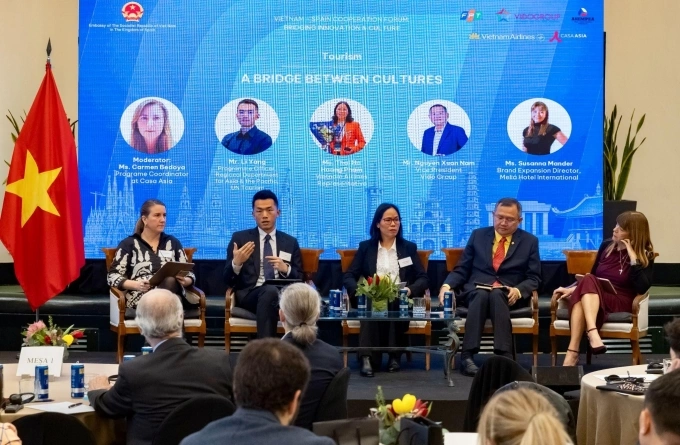
Nguyen Xuan Nam, Vice President of VidoGroup, said: “High-end tourism today is no longer about facilities but about emotion and authentic experiences that people carry with them long after the journey ends.”
Vietnam welcomed 17.5 million international visitors in 2024, up nearly 39% year-on-year, with arrivals exceeding 21 million in 2025. Spanish outbound travel remains significantly higher, suggesting room for further growth in bilateral tourism.
Vietnam Airlines said it is focusing on improving connectivity and passenger experience. The carrier currently operates about 37 weekly connections between Spain and Vietnam via European hubs and is considering a direct Madrid-Hanoi route. It also aims to achieve five-star airline status by 2030.
 |
|
Delegates during “A bridge between cultures” panel discussion. Photo courtesy of FPT |
Technology and AI cooperation
Technology and artificial intelligence were highlighted as key areas of collaboration. Participants noted that Spain operates within a mature regulatory and digital environment, while Vietnam is emerging as a fast-growing technology hub.
FPT Corporation said it is expanding its presence in Europe, including Spain, and continues to invest in AI and advanced computing. The company operates in 30 countries and benefits from a workforce of around one million IT professionals in Vietnam.
FPT representatives said AI applications are already being deployed in sectors such as public administration, insurance and enterprise software. The company also integrates training through FPT University to align workforce skills with industry needs.
Spanish and European participants highlighted Vietnam’s growing role as a technology and IT services partner.
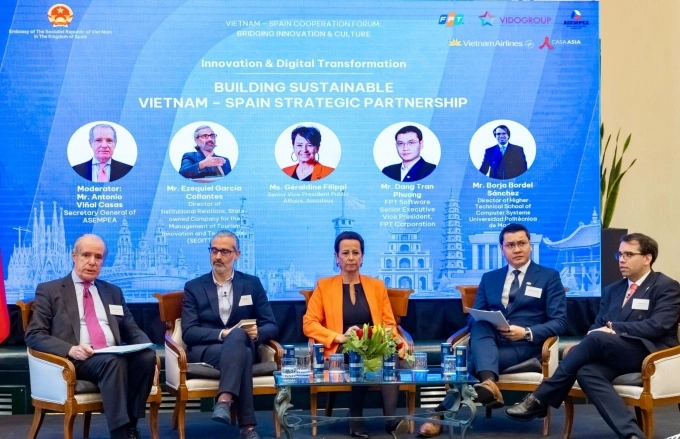
Dang Tran Phuong, FPT Software SEVP, said: “For Spanish companies, the next chapter with Vietnam is not about sourcing; it’s about building strategic delivery centers, long-term managed services, and co-investing in talent.”
Géraldine Filippi, SVP Public Affairs at Amadeus, added: “For AI to deliver real value, data must move securely and predictably across borders, and that requires geopolitical stability, regulatory clarity, and interoperable digital infrastructure.”
 |
|
Delegates during “Building Sustainable Vietnam-Spain strategic partnership” panel discussion. Photo courtesy of FPT |
From dialogue to implementation
Participants agreed that Vietnam-Spain cooperation is entering a more practical phase, with opportunities to expand partnerships in tourism, technology and workforce development.
The forum concluded with a shared view that stronger coordination between businesses and institutions will be key to translating discussions into long-term projects.