Instant noodles producer Nongshim’s CEO Cho Yong-chul told employees at the start of 2026 that the company’s guiding principle for the year was “global agility and growth”, encouraging staff to expand its international presence.
 |
|
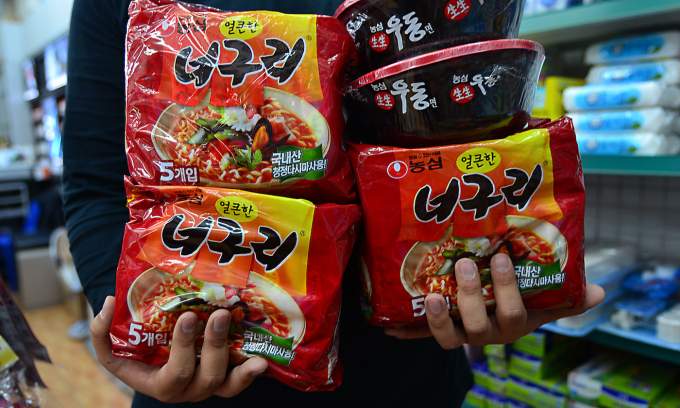
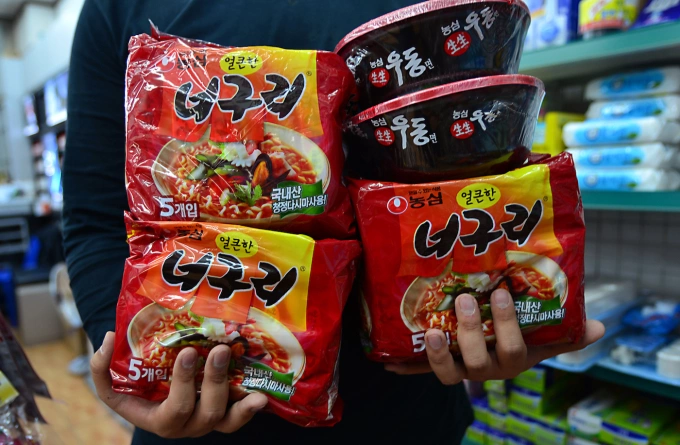
A South Korean store employee holds Nongshim brand Korean instant noodles in Seoul, South Korea. Photo by ZUMA Press Wire via Reuters |
The maker of Shin Ramyeon noodles, which commands more than 60% of the local market, is looking beyond South Korea because the domestic market is already saturated, said Oh Jiwoo, an analyst at financial services provider CGS International, as quoted by CNBC.
“Their main product was first invented in 1970s and 80s. And those same products are selling every year, with no marketing cost,” she said.
South Korea’s demographic decline further constrains long-term domestic growth, pushing firms to seek expansion abroad, Oh added.
Just as K-pop and K-drama companies are seeking overseas growth, Korean food manufacturers – particularly noodles producers – are doing the same, she said.
Food company Otoki CEO Hwang Sung-man said at a shareholder meeting in March last year that the company, best known for Jin Ramen, would focus on “exploring global markets” and target overseas sales revenue of KRW1.1 trillion won (US$746 million) by 2030.
Noodle makers have even tapped into K-pop’s global appeal by signing high-profile ambassadors.
Nongshim appointed SM Entertainment girl group Aespa as global ambassadors in late 2025, following a collaboration with Netflix on a K-pop Demon Hunters-themed noodle line.
Otoki has enlisted BTS member Jin as the face of Jin Ramen.
K-Food exports
Exports of “K-Food+”, a category covering food products and agricultural industries, climbed to a record $13.62 billion in 2025, according to the South Korea Ministry of Agriculture, Food and Rural Affairs said.
The figure marked a 5.1% rise from the previous year and extended a decade-long streak of annual growth.
 |
|
Visitors eat snacks near a ‘KPop Demon Hunters’ themed zone at the Everland Resort, South Korea’s largest theme park, in Yongin, Gyeonggi Province on September 30, 2025. Photo by AFP |
The rise was driven by instant noodles. Overseas shipments surged nearly 22% to $1.5 billion, making instant noodles the first single food category to exceed $1 billion in export sales.
New offerings such as cheese-flavoured spicy noodles have found strong demand in China, the United States and emerging markets in Central Asia and the Middle East.
“Global demand for Korean noodles continues to expand, and companies have scaled up production and stabilized supply chains to meet it,” the ministry said in a late-2025 report.
The rise in demand for instant noodles comes as developed countries struggle with inflation, making consumers more open to cheaper food options.
A November report by Australia-based financial group Macquarie said inflation has expanded the U.S. noodle market as consumers look for affordable and convenient meals.
Oh noted that dining out in the U.S. and Europe is costly. “Consumers want to save more, then they try instant noodles; it’s great and it’s cheap.”
U.S. inflation for “food away from home” reached a 13-year high of 5.3% in 2021 and peaked at 8.8% in March 2023, according to the U.S. Bureau of Labor Statistics. While inflation has eased since then, the category most recently recorded a rate of 4.1%.
At home, South Korean instant noodle makers face government-imposed limits on price increases, which restrict their ability to pass on higher costs, Macquarie said.
Overseas markets, by contrast, allow for higher average selling prices, Oh said. She added that prices in China and other Asian markets can be 30% to 50% higher than in South Korea, while U.S. prices can be roughly double.
Industry watchers say the expanding range of premium instant noodles signals a gradual move away from the product’s image as a budget meal, driven largely by its growing global profile, according to The Korea Times.
India-based Persistence Market Research projects the global instant noodle market will grow from $55 billion in 2025 to $100 billion by 2030.
This expansion, coupled with South Korea’s shrinking domestic consumer base due to a low birthrate and a growing focus on healthier diets, is prompting companies to pursue premium product strategies more aggressively.
Macquarie said leading Japanese and Korean brands have benefited from changing consumption patterns by focusing on “product innovation and cultivating a premium brand image.”
“We believe premium instant noodles with strong product innovation will be the key driver for U.S. market,” it said.