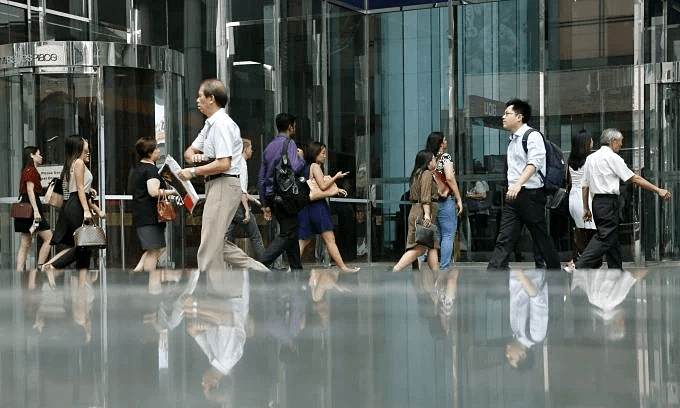
Some 56% of employees in Singapore said they feel somewhat or extremely happy at work, according to a survey by Seek, which runs job portals including JobStreet in Singapore and JobsDB in Hong Kong.
Seek surveyed 1,000 respondents aged 18 to 64 in Singapore between October and November last year. It also polled workers in Hong Kong, Thailand, the Philippines, Malaysia, Indonesia, Australia and New Zealand.
The other Southeast Asian countries surveyed lead the broader region in workplace happiness. Indonesia ranked highest with 82% of respondents saying they feel somewhat or extremely happy at work, followed by the Philippines at 77%, Malaysia at 70% and Thailand at 67%.
They are followed by New Zealand and Australia at 65% and 57%, respectively. The lowest figure in the region was 47% in Hong Kong.
 |
|
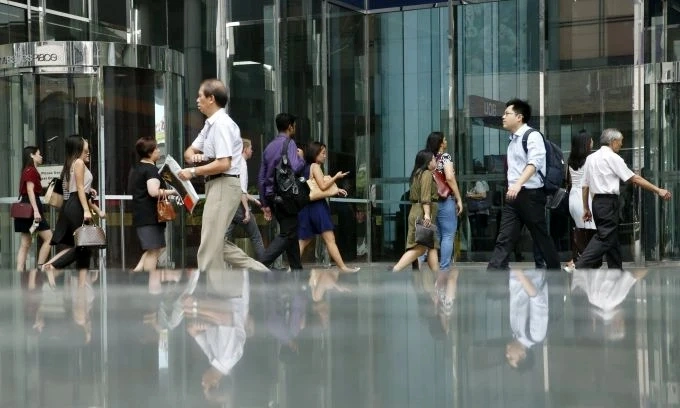
Office workers walk to work during morning peak hour commute in the central business district in Singapore, March 24, 2016. Photo by Reuters |
In Singapore, nearly half of surveyed workers said they feel burnt out or exhausted, according to Mothership.
Notably, 41% of those who described themselves as happy also reported experiencing burnout. Of these, 51% earn over S$6,000 (US$4,714) a month.
Men (63%) and parents (66%) were also more likely to say they feel burnt out despite being happy at work.
Stress levels, career progression and senior leadership were the most commonly cited reasons for workplace unhappiness.
Higher pay topped the wishlist when respondents were asked what could improve their happiness at work, with 64% placing it in their top five priorities, AsiaOne reported.
A similar trend was seen in Hong Kong, where 69% said a pay rise would improve their workplace happiness.
However, the study found that long-term happiness at work is shaped by other considerations. For those in Singapore, a sense of purpose ranked as the strongest driver, followed by career progression opportunities and satisfaction with their day-to-day roles.
Among Gen Z workers aged 18 to 29, flexible working arrangements ranked first, followed by career progression and salary.
Even so, only around half of respondents said they were content with their sense of purpose, while just 37% felt optimistic about their career progression. Half of respondents also reported not feeling adequately appreciated for their work.
“What our latest Workplace Happiness Index shows us is that Singapore’s workers are not disengaged or unmotivated, but rather feeling stretched and undervalued,” said Esther Lee, managing director of Jobstreet in Singapore.
“With one of the lowest happiness levels in the region, this should serve as a warning sign to employers that burnout, stalled progression and unequal opportunity are becoming business-critical issues, not just HR concerns.”