Last year’s closures rose 9.27% from a year earlier to their highest level since 2016, when 60,746 businesses shuttered, according to data from the Singapore Department of Statistics.
The 2025 figure was also the third-highest on record since 1990, with the peak being 63,406 in 2005.
By industry, wholesale trade accounted for the largest number of closures at 9,980, followed by professional services with 9,616 and information & communications with 7,550.
On the other hand, business formations increased 9% year-on-year to a record 78,146, led by professional services with 13,409 new firms.
Wholesale trade and information & communications followed with 12,048 and 9,991, respectively.
A combination of factors has contributed to the increase in business closures last year. Rents for small shops in some popular districts such as Kampong Glam have doubled or even tripled in recent years. Higher wages and input costs have also squeezed businesses’ already thin margins, according to Vulcan Post.
As more businesses entered the market, the competition for both customers and talent among firms has become increasingly tough.
 |
|
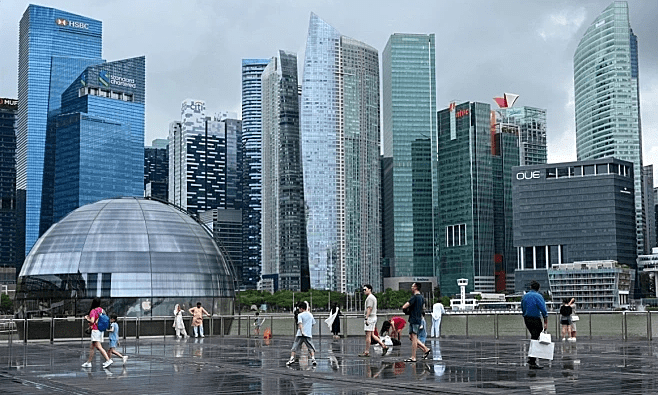
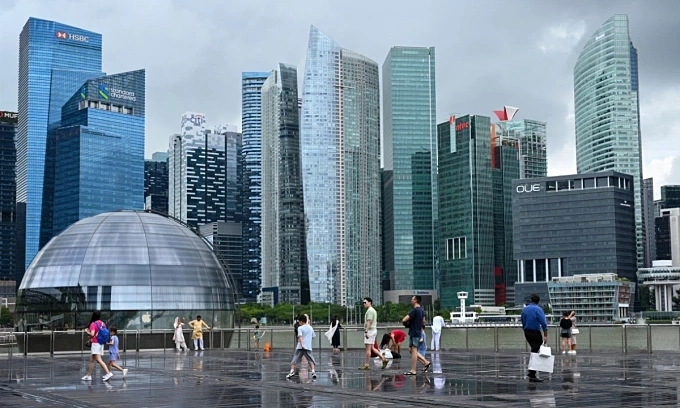
People gather on the boardwalk at Marina Bay in Singapore on Jan. 9, 2024. Photo by AFP |
Many enterprises also face debt and liquidity strains. The number of compulsory winding-up applications and liquidations both reached a 15-year high in 2025, as reported by The Business Times, citing data from the Ministry of Law.
Some 492 applications were filed during the year, a 23% increase from 2024, and 392 companies were ordered to wind up, up 27.7%.
Food and beverage closures
Despite multiple high-profile shutdowns, including decades-old heritage eateries and some Michelin-starred restaurants, the food and beverage sector was not among the top five for business cessations.
The sector ranked seventh with 3,074 closures, up 0.85% year-on-year, while 4,103 new businesses were formed, resulting in a net increase.
Between 2015 and 2025, the sector recorded a net increase of 42% in F&B entities, according to Alvin Tan, Minister of State for Trade and Industry.
“The food services sector is highly competitive due to low barriers of entry, high product substitutability and rapidly shifting consumer preferences,” Tan said in a February parliament sitting, as quoted by Mothership.
Overall, the total number of new firms across sectors has continued to outnumber closures in the first two months of 2026, with 12,824 formations and 8,283 cessations.
Some notable F&B exits this year were 45-year-old Miow Sin Popiah and Carrot Cake Stall, which closed in February, and Japanese restaurant chain Itacho Sushi, which shut all Singapore outlets in March.
Other noteworthy closures outside the sector included delivery platform Deliveroo, which exited Singapore in March, and food wholesaler FoodXervices, which recently announced plans to wind down after 92 years in business.