Speaking to VnExpress on the sidelines of the “Investment Outlook 2026” event on March 12, Suan said Vietnam’s economic outlook for 2026 remains positive, supported by exports, public investment and steady FDI inflows. He added that sustaining and upgrading FDI will increasingly depend on policy quality and the overall business environment, rather than cost advantages alone.
What is UOB’s forecast for Vietnam’s economic outlook in 2026?
Overall, Vietnam’s economic outlook for 2026 remains quite positive despite the current global uncertainties. Developments in the Middle East are something we need to monitor closely because they may affect oil prices, particularly in the early part of the year.However, beyond these short-term developments, it is also important to consider how Vietnam has already navigated major challenges in the past year.
 |
|
Suan Teck Kin, Head of Global Economics and Markets Research at UOB. Photo courtesy of UOB |
In 2025, the Vietnamese economy demonstrated resilience despite disruptions by tariff. As we move into 2026, the tariff situation has moderated somewhat, although we still need to monitor developments in sector-specific tariffs. Taking all these factors into account, and based on the lessons learned in 2025, we believe the overall outlook for Vietnam in 2026 remains stable and positive.
What will be the key trends or drivers of Vietnam’s economic growth in 2026?
Exports will remain one of the most important drivers of Vietnam’s economic growth in 2026. In 2025, Vietnam recorded strong export performance with double-digit growth, and this momentum is expected to continue. Strong export demand supports manufacturing activity, which remains a key pillar of Vietnam’s economy.
Another important factor is the continued global investment in artificial intelligence (AI) and advanced technologies. This investment is increasing demand for semiconductors, electronics, and related components. As Vietnam plays an increasingly important role in electronics and technology manufacturing, these sectors could become important growth drivers for the economy in 2026.
How do you see FDI flows into Vietnam this year?
Looking back at 2025, many people initially expected that the tariff developments would significantly affect foreign direct investment because companies might become uncertain about their expansion plans. However, what we observed at the end of the year was quite different.
Companies proved to be flexible and resilient, and the longer-term trend of supply chain diversification into Southeast Asia continued. In fact, Vietnam recorded another strong year of FDI inflows.
For 2026, it is difficult to say whether FDI will reach another record level, but the underlying trend remains intact. Companies are still diversifying supply chains, exploring new production locations, and looking for new markets. Therefore, we expect FDI inflows into Vietnam to remain strong this year.
What are the key sectors attracting FDI into Vietnam, and what policy measures are needed to help Vietnam remain competitive, particularly in attracting high‑tech FDI?
Vietnam continues to attract strong FDI inflows, with manufacturing remaining the main sector, while retail and tourism‑related industries are also gaining interest, in line with broader Southeast Asian trends.
 |
|
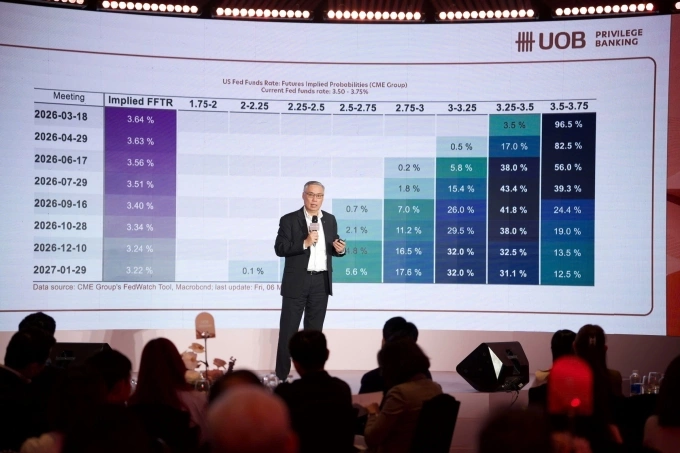
Suan speaking at the event. Photo courtesy of UOB |
Looking ahead, the priority is to sustain Vietnam’s competitiveness, especially in attracting high‑tech and higher‑value FDI. While existing policies have been effective in drawing foreign investors, future efforts should focus on ensuring companies stay, expand and upgrade their operations in Vietnam.
Key policy priorities include enhancing workforce training and education, strengthening coordination across government agencies, and fostering closer collaboration with industry. Although Vietnam currently benefits from a large labor force, competitive costs and a favourable exchange rate, these advantages will not last indefinitely. Continued emphasis on human capital development, innovation and productivity will be essential to maintaining Vietnam’s appeal as a long‑term FDI destination
How important is public investment for Vietnam’s economic growth?
Public investment will remain an important pillar of Vietnam’s economic development. The government’s plans for the 2026–2030 period emphasize increasing investment in infrastructure. This includes roads, ports, logistics systems, energy supply, water systems, and digital infrastructure.
These investments are critical because they help improve productivity and efficiency across the economy. While exchange rate competitiveness can support growth for a period of time, in the long run what matters most is productivity. Improving infrastructure and efficiency will help businesses grow, create jobs, and raise income levels across the population.