The quiet town in the state of Pahang once gained national attention in the early 1900s for its gold, with miners scooping flecks of the metal from trays of freshly dug sand.
Today, Raub’s economy has shifted to a different kind of “gold.” Its hillsides are home to an estimated 150,000 durian trees spread across about 2,000 hectares of state land, according to The Straits Times.
The fruit has long divided opinions, with some praising it as the “king of fruits” for its sweet taste and creamy texture while others shun it for its pungent smell.
Yet it has found eager buyers in China, where demand appears boundless. In recent years, the fruit has also taken on a new cachet there, consumed not only fresh but reworked into a wave of desserts and sweet treats, as well as more unconventional offerings such as durian milk tea and hot pot.
Among the fruit’s many varieties, Musang King, which Raub is famous for, stands out for its bittersweet taste and its premium status. Chinese consumers have called it the “Hermès of durians,” likening it to the French maker of US$10,000 Birkin bags.
 |
|
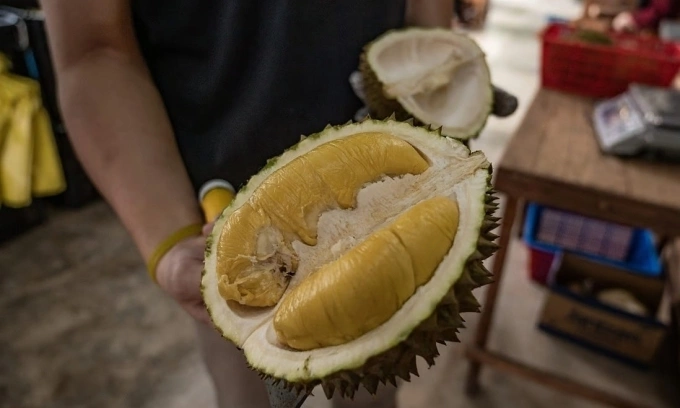
A worker shows a ‘Musang King’ variety of durian called at a shop in Kuala Lumpur. Photo by AFP |
“Once I ate Malaysian durian, my first thought was, ‘Wow, this is delicious. I have to find a way to bring it to China’,” Xu Xin, who imports and sells the fruit in northeastern China, told the BBC.
In Southeast Asia, where durians are widely cultivated, prices typically begin at under $2 per fruit, but premium varieties like Musang King can fetch $14-100 each, depending on quality and the season.
China absorbs roughly 60% of Malaysia’s durian exports, making it the Southeast Asian country’s largest overseas market for the fruit.
Between 2018 and June 2025, Malaysia shipped a total of 115,359 tons of durian products, including pulp, paste, and frozen and fresh whole fruits, worth RM6.37 billion (US$1.51 billion) to China, national news agency Bernama reported last October.
In 2024 alone, China imported RM1 billion worth of the fruit from Malaysia following a bilateral agreement that opened the door to fresh durian shipments. Malaysia had been limited to frozen products before that.
Though Malaysia only holds a minuscule share of the market compared to the two top suppliers, Thailand and Vietnam, it has garnered a reputation for premium varieties like the Musang King.
Raub, also called the “Musang King Durian Town,” has been a major beneficiary of the boom.
“The soil (in Raub) is very suitable for cultivating durians. Also, the climate is very good,” Lu Yuee Thing, who owns a local farm called Uncle Thing Durian Leisure Farm, says.
The town’s geographical location, he added, is also ideal for growing the luxe variety the town is known for.
Musang King millionaires
As the trade expands, it has minted millionaires among local durian business owners, including Eric Chan.
Over a decade ago, when the fruit was cheap and typically sold off trucks by the roadside, Chan pivoted from writing code for satellites and robots to starting his company, which supplies durian paste used for various dishes.
He later sold a controlling share in the firm for about $4.5 million, roughly 50 times what he had put in at the start.
Remarking about Raub’s once-poor durian farmers, Chan told The New York Times: “Everybody has been making good money.
“They rebuilt their houses from wood to brick. And they can afford to send their children overseas for university.”
Durian farm owner Jovi Kong says he began planting the fruit more than a decade ago and has since accumulated assets including luxury cars and two landed properties, one in Raub and another in Kuala Lumpur.
“Raub is very different from other Malaysian towns, the people living here are rich,” Kong told Channel News Asia in 2019.
 |
|
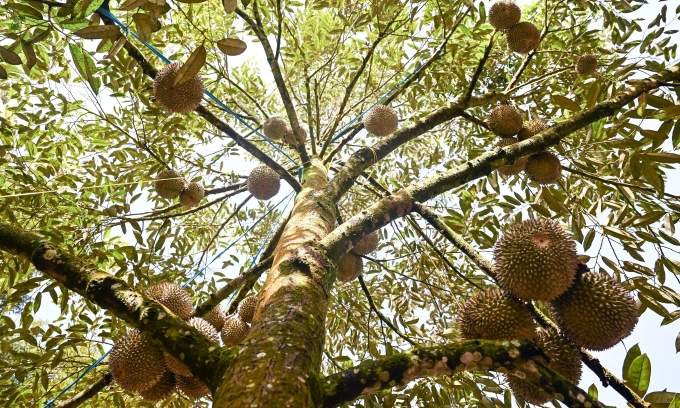
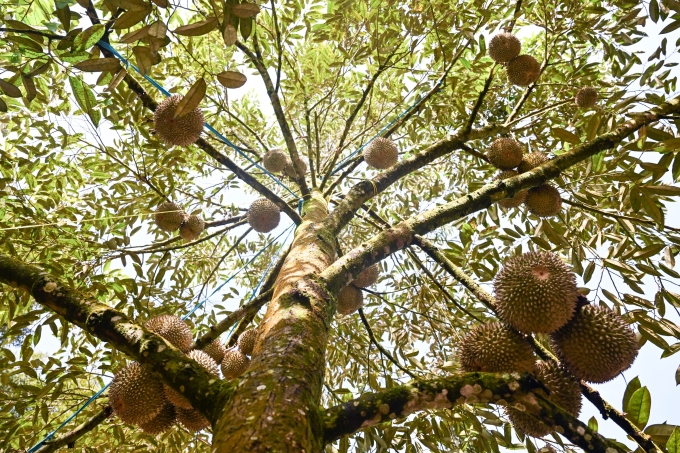
Durians are seen on the tree at a durian orchard in Raub of Pahang state, Malaysia, Oct. 16, 2025. Photo by Xinhua via AFP |
Even so, durian farming is a tough job. 72-year-old Lu, locally known as Uncle Thing for his durian business, rises before sunrise each day and navigates his steep, uneven farm to gather ripe fruit.
A falling durian struck his shoulder a few years ago, leaving him with lingering pain that still flares up from time to time.
“It looks like farmers make easy money. But it’s not easy,” he says.
Lu began growing durians in the 1980s, starting with kampung varieties. In the early years, he recalls, durian farming brought little profit as prices were volatile.
“It was so terrible that some [farmers] began planting oil palm instead,” he says, adding that he had also similarly converted some of his land.
As the industry matured, businesses shifted to better varieties and exports of Musang King began to generate profits.
“Durian has contributed a lot to the economy here,” he says.