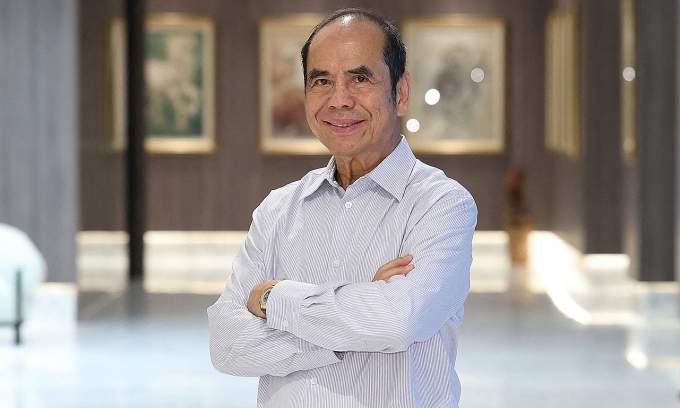
Earning the title of “popiah king” for growing his flagship firm Tee Yih Jia into one of the world’s largest producers of popiah skins, Goi, 79, ranked 22nd on Forbes’ list of the richest Singaporeans last September. His net worth is estimated at US$2.7 billion.
Yet the food industry was not where he originally planned to build his career.
Born to a father who was a farmer in China’s Fujian province, Goi moved to Singapore with his family at the age of 6 and settled in Geylang, where his father ran a small grocery store.
Goi left high school to help at his father’s business but soon took on odd jobs at a mechanical repair shop, where he discovered a knack for fixing machines.
In 1969, a 21-year-old Goi convinced his father to lend him $8,000 to open his own repair shop.
“I started working when I was very young; leaving school to help my family business in a provision shop,” Goi told the Financial Times in 2015. “I always wanted to be my own boss, which probably stemmed from the fact that my father was a businessman.”
 |
|
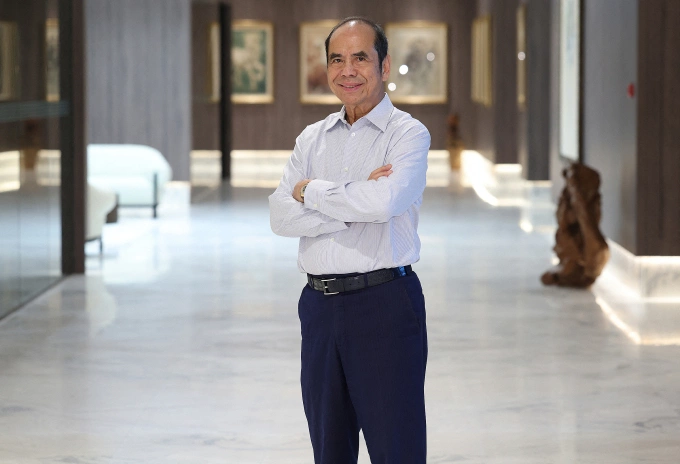
Sam Goi, Executive Chairman, Tee Yih Jia, a frozen food manufacturing company. Photo by SPH Media via AFP |
The venture, however, failed and shut down within a year. Having learned a lesson, he returned to the trade, setting up a mechanical engineering workshop serving businesses in Jurong, which proved far more successful.
He later came across popiah skins at a nearby factory that produced them. He had earlier befriended its owners and, as it was struggling with feuding partners, he acquired a controlling stake in the business for $370,000, funded by his savings and a bank loan, as a favor to a friend.
But a partner quietly launched a similar operation under the same name in Malaysia. Upon learning this, Goi bought him out and assumed full control of Tee Yih Jia in 1980.
He then overhauled the company’s labor-intensive production line, introducing full automation and focusing on technological upgrades and factory expansion.
“With my engineering background, I designed the world’s first automated system for making top-quality spring roll pastries,” he recalled. “I got technicians from Europe and Japan to develop the machines. There were long hours of trials and retrials; the factory became my home for months at a stretch.”
Goi noted that automation ensured consistent quality and hygiene while sharply reducing manpower needs, a major advantage in labor-starved Singapore.
Tee Yih Jia leveraged the “Made in Singapore” label, which at the time gave local food exporters an edge overseas, to expand beyond the city-state.
Goi has frequently been highlighted by the government as a homegrown success story and has also acknowledged this advantage.
“The strength of Singapore’s brand equity has opened doors around the world for me,” he told Forbes in 2011, when he first made the magazine’s Singapore rich list.
His business has broadened its offerings over the years to include popiahs themselves, as well as ready-to-eat Asian products like fortune cookies, samosas and prawn rolls.
Goi, meanwhile, has diversified his interests beyond food, investing in property and hospitality through GSH Corporation, which holds a number of hospitality and residential assets in Malaysia and China, according to The Straits Times.
His business empire also includes packaging company Tat Seng Packaging and consumer goods distributor and manufacturer PSC Corporation.
“I’m a simple man who started in a small way with the humble popiah. But now we’ve gone far beyond that.”
Family succession
As is tradition in many established Asian family businesses, Goi has been planning to pass the torch to the next generation.
“I have been training my children and loosening my grip on the business to allow my children to do things on their own,” Goi, who is married and had four children, told The Business Times in 2015.
The siblings shared the responsibility of carrying forward the family legacy.
Last month, Goi’s eldest son, Kenneth Goi, was named chief executive of PSC, with the appointment effective May 5.
One of Goi’s daughters, Laureen, serves as general manager of Tee Yih Jia. The youngest son, Ben, had previously run the firm before his death in 2019.
Eldest daughter Lang Peng had worked as a marketing manager at Tee Yih Jia from 1996 to 2002 before moving into education. She later served as a non-executive director at another company controlled by Goi until 2023.
Goi has said he welcomes his children taking over the business: “I’m quite happy. I would like to take it easy and spend more time on society and charity work.”