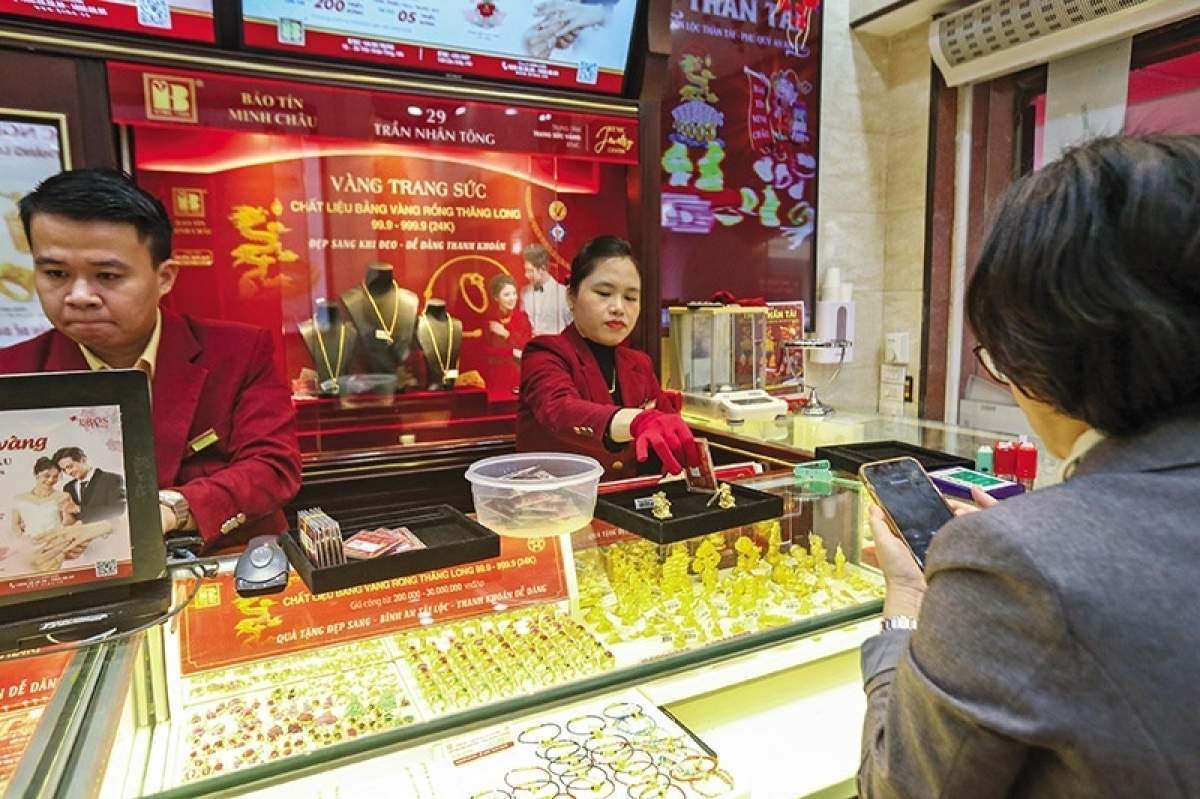
Speaking to the media in Hanoi on December 29, Dao Xuan Tuan, director general of the Foreign Exchange Management Department under the SBV, said that following a government decision on August 26 on gold bullion market management, the SBV has received nine applications for licences to produce gold bullion.
Businesses holding gold bullion production licences might be considered by the SBV for permission to import gold.
“At present, the SBV is coordinating with relevant ministries and agencies to review and grant gold bullion production licences to eligible banks and enterprises in strict accordance with regulations. In reality, banks and businesses are also being cautious when applying for gold import licences,” Tuan said.
 |
| The bullion market’s prospects are upbeat in the long-haul. Photo: Duc Thanh |
Regarding the establishment of a gold exchange, Tuan noted that this is a major government policy, with the SBV serving as the lead implementing agency.
The central bank is currently collecting feedback from ministries and agencies on the matter and will report to the prime minister on the selection of a model suitable for Vietnam.
Tuan said the SBV has received numerous recommendations from experts and businesses on setting up a gold exchange.
However, both domestic and international experience shows that while a gold exchange can bring benefits if properly designed, it also entails significant risks if there exists an inadequate legal framework, insufficient supervisory mechanisms, and weak coordination among regulatory authorities.
Accordingly, the SBV’s orientation is to continue studying the gold exchange model based on a comprehensive and cautious approach, with a clear roadmap, and above all in alignment with the objective of macroeconomic stability and Vietnam’s practical conditions.
As of now, domestic gold prices have shot up by about 90 per cent compared with the end of 2024.
According to the latest forecast by J.P. Morgan Global Research, gold prices could average $5,055 per ounce in the fourth quarter (Q4) of 2026. In a scenario where investment demand surges and central banks continue net purchases, prices could even climb to $5,400 per ounce.
From another perspective, senior economic and financial expert Nguyen Tri Hieu believes there are few factors strong enough to drive gold prices down over the next 12 months, given ongoing global geopolitical complexities, unresolved US-China trade tensions, and the risk of resurging inflation.
In his view, gold prices could soon touch $5,000 per ounce.
On the international market, buying demand from large institutions remains robust. Notably, many central banks that previously purchased gold in limited volumes have now shifted to strong net buying.
The gold market is also witnessing the entry of new players, most notably Tether Limited, a major name in the cryptocurrency space.
Despite positive long-term prospects for gold, in the Vietnamese market gold is not considered a safe investment channel for short-term trading, given its staggering price upsurge this year.
Short-term investors face numerous risks, particularly the possibility that the price gap between domestic and global gold prices could narrow if the SBV gives the nod to gold imports.
Banking expert Pham Xuan Hoe analysed that the extent to which the price gap narrows will depend on the SBV’s regulatory approach.
If import licensing proceeds smoothly with sufficiently large volumes, the gap could shrink from the current level of nearly VND20 million ($800) per tael to around $240-$400 per tael, though a rapid reduction in a short period would be difficult.
Sharing the same view, expert Phan Dung Khanh said the gold price gap in 2026 is likely to narrow, and domestic gold prices could even reverse direction. As such, investors should not buy gold for short-term speculation due to high risks.
“Gold prices have reached a record high at around $4,500 per ounce. Prices may continue to rise, but the possibility of a correction cannot be ruled out. If investing in gold, investors should only use idle funds and allocate a small proportion,” Khanh advised.
Regarding the gold exchange issue, in theory, establishing an exchange could help reduce the tendency to hold physical gold, enhance transparency, support cash flow management, and pivot gold holdings among the public for economic development.
However, expert Pham Xuan Hoe cautioned that issuing bonds or gold certificates to mobilise gold from the public also carries significant risks, especially amid strong price volatility.
“Therefore, the establishment of a gold exchange needs to be studied and calculated with utmost caution,” he noted.
 |
Gold market rejuvenation on horizon
Beyond identifying physical gold bars or establishing a gold exchange, fresh proposals have gone further, including the introduction of securities-like accounts at banks and gold trading enterprises. |
 |
Gold market embarks on new rebuilding trajectory
The State Bank of Vietnam is simultaneously tightening oversight and advancing plans for a national gold exchange, placing banks and businesses to seize opportunities while facing a more transparent and disciplined market. |
 |
Global gold exchange models offer roadmap for Vietnamese market
Lessons from world-leading gold exchange models in vibrant precious metals markets such as Singapore, Shanghai, and Thailand could provide useful direction for Vietnam as it works to build a modern, transparent gold market aligned with global standards. |