Looking back at 2025, how would you assess the journey the finance sector has gone through?
In 2025, despite numerous challenges, under the sound leadership of Party General Secretary To Lam, the Politburo, the Party Central Committee, and the National Assembly, and also under the drastic direction of the government and the prime minister, our country has reaped comprehensive outcomes across all sectors.
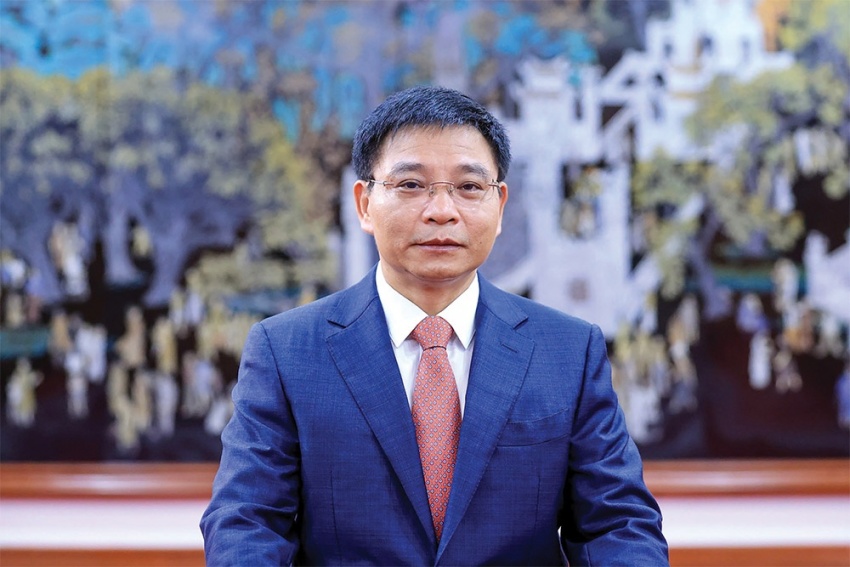 |
| Minister of Finance Nguyen Van Thang |
Within this overall success, the financial sector made important contributions with many notable achievements.
The entire sector upheld solidarity, responsibility, and creativity, ensuring the smooth operation of the newly reorganised apparatus while fully delivering on tasks related to state finance and budget management, investment, and socioeconomic development.
Requirements were increasingly demanding, while the organisational structure was undergoing consolidation and streamlining. In response, the Ministry of Finance (MoF) thoroughly implemented the principles of discipline, accountability, efficiency, and acceleration, rolling out tasks in a coordinated manner across all areas.
The ministry advised the Politburo on issuing a resolution on private sector development; submitted 28 laws and resolutions for approval; proposed 86 decrees and resolutions to the government; and issued 144 circulars, accounting for around one-quarter of all legal normative documents approved nationwide during the year.
These regulations not only addressed economic obstructions but also established legal frameworks for emerging and complex areas such as science and technology development, innovation, and digital transformation; the establishment of an international financial centre; and the formation of new financial markets and products, including digital assets.
Fiscal policy was managed in a targeted expansionary manner, closely and effectively coordinated with monetary and other macroeconomic policies to stabilise the macroeconomy, control inflation, safeguard major economic balances, and lay a solid foundation for growth.
Administrative reform continued to accelerate, with public services modernised to improve the business and investment climate and create maximum convenience for citizens and enterprises.
At the same time, the financial sector implemented various measures to unlock resources for development investment and successfully upgraded the stock market, expanding market scale and attracting foreign capital linked to science and technology development. These results added bright highlights to Vietnam’s fiscal landscape in the final year of the term and created strong confidence heading into a new development phase.
State budget revenue was a particular bright spot in 2025. Could you elaborate?
State budget revenues last year reached the highest level ever. Total revenues amounted to approximately $106.6 billion, exceeding the estimate by 35.53 per cent, despite the implementation of large-scale tax and fee exemptions, reductions, and deferrals worth nearly $10 billion to support businesses and households.
This performance reflects the resilience and recovery capacity of the economy, as well as the effectiveness of revenue management, base broadening, and revenue nurturing, alongside positive impacts from digital transformation in public finance.
More importantly, the revenue structure has become increasingly sustainable, driven mainly by production and business activities. This provides a critical foundation for safeguarding national financial security and creating fiscal space for development objectives in the coming years.
On the expenditure side, the state budget prioritised development investment. The PM assigned a record public investment plan exceeding $44 billion for 2025, helping to crowd in private investment and open new growth spaces. Cumulative expenditure for the year is estimated at $97 billion, equivalent to 94.1 per cent of the budget estimate.
Higher revenues and spending savings were mobilised, for example, to fund boarding schools for students in remote and disadvantaged areas, cover costs arising from organisational restructuring from central to local levels, promptly address disaster recovery, and meet other urgent needs.
Ultimately, these figures all serve a single objective: putting people at the centre, safeguarding social welfare, and advancing sustainable development.
There has also been an unprecedented organisational restructuring in the financial sector. How did this affect governance and operations?
The consolidation and merger of agencies was a major decision with long-term strategic significance. Initial implementation inevitably posed challenges, as the new apparatus had to operate while being refined, amid an expanding workload.
However, thanks to close guidance from the Party, state, government, and prime minister, and the strong sense of responsibility across the sector, the new organisational structure quickly stabilised and operated smoothly, without disrupting financial and budgetary management.
Over the longer term, organisational restructuring and streamlining will enable the finance sector to enhance its effectiveness and efficiency, while strengthening coherence and unity in policy advice and the management of fiscal-budgetary policy, investment, and socioeconomic development. This also represents a critical preparatory step for the sector to meet higher development demands in the coming period, as the economy continues to expand in scale and complexity.
The financial sector has been tasked with implementing multiple major Party resolutions that require substantial resources. How will the MoF balance development goals with fiscal discipline?
The simultaneous rollout of multiple major Party resolutions within a single period places exceptionally high demands on the management of public finance and the state budget. At the same time, it presents a critical opportunity for the MoF to fundamentally reshape its approach to resource allocation, towards greater efficiency, sustainability, and clear strategic focus.
The ministry adheres to the principle of aligning budget management with medium- and long-term development goals, maintaining fiscal discipline and public debt safety while retaining flexibility to prioritise strategic tasks identified by the Party.
The MoF will continue to restructure the state budget by increasing the share of development investment, rigorously curbing recurrent expenditure, and enhancing the efficiency of every unit of public capital. In this framework, the state budget will act as catalytic capital, concentrating on strategic areas, thereby crowding in and mobilising maximum social resources, particularly from the private sector, foreign investors, and other legitimate funding sources.
In parallel, the financial sector will further refine the fiscal and budgetary institutional framework towards greater transparency and disclosure, strengthen decentralisation and delegation, and develop financial markets in a more synchronised manner to diversify funding channels for the economy, easing pressure on the state budget. Revenue administration will also be intensified through broadening the tax base, preventing revenue leakage, and nurturing sustainable sources of income, thereby creating fiscal space for the effective implementation of the Party’s and state’s major policy priorities.
Entering the first year of the 2026-2030 term, what are the sector’s key priorities to realise the goals set by the 14th National Party Congress?
The MoF will focus on six priority task groups. Firstly, it will effectively implement the resolution of the 14th National Party Congress and advise on the timely issuance of all guiding documents for newly adopted laws and resolutions, targeting completion by the first quarter of 2026 in line with the Party general secretary’s directive, so that Party policies can be brought into practice swiftly and effectively.
Secondly, the MoF will fully institutionalise and implement Party resolutions on developing all economic sectors, accelerate the restructuring of governance and capital at state-owned enterprises, and improve operational and investment efficiency to reinforce the role of the state economy.
At the same time, it will foster the private sector as a key growth engine, expand markets for the collective economy and cooperatives, and engage and deploy foreign investment more effectively, thereby strengthening growth foundations and enhancing economic resilience and competitiveness.
Thirdly, it will continue to pursue a targeted expansionary fiscal policy, closely coordinated with monetary and other macroeconomic policies to support high growth while safeguarding national financial security and macroeconomic stability. Public investment will be restructured for greater efficiency, with resources prioritised for projects that reshape development space and momentum, guided by strict economic efficiency criteria.
Fourthly, we will advance the development of a modern, transparent, and integrated stock market as a primary channel for medium- and long-term capital mobilisation, while attracting international investment funds. It will also refine the legal framework for new economic models and financial products, including the knowledge and circular economies, carbon markets, green bonds, and digital assets.
Fifthly, policies will be regularly reviewed and assessed for effectiveness, with institutional and procedural impediments decisively removed. Integrated, long-term planning will be strengthened alongside regional and sectoral links, comprehensive digitalisation of financial public services, and the streamlining of administrative procedures. This will foster a transparent and competitive environment and help form new growth poles, key economic zones, and special economic zones with regional and global competitiveness.
Sixthly, policy communication will be further intensified through stronger dissemination and enforcement of laws and regulations, building broad consensus among the public and business community, and ensuring close alignment between lawmaking and law enforcement, with greater discipline and accountability in policy implementation.