
 |
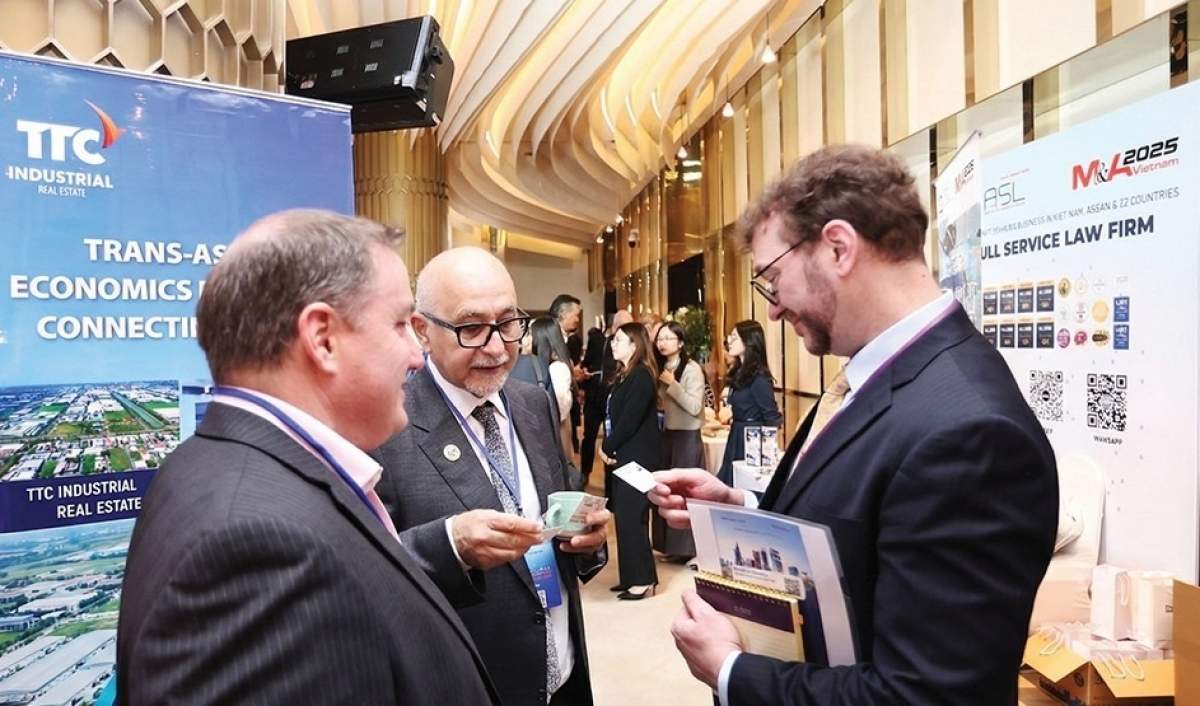
| Experts have highlighted the positive signals in Vietnam’s M&A arena amid general global struggles, photo Le Toan |
According to KPMG Vietnam, Vietnam recorded around 220 M&A transactions this year up to November, with a total deal value of $2.3 billion. The average deal size reached $29.4 million, down from the peak of $50.7 million in 2024. This reflects a more cautious approach to due diligence, with investors prioritising strategic and sustainable assets over pure scale, it said.
The sectors attracting the most M&A capital include real estate (27 per cent), driven by improved liquidity; materials, supported by supply-chain relocation trends; and healthcare, buoyed by rising demand from the expanding middle class.
“These three sectors account for more than half of total M&A value, indicating a clear shift towards assets with intrinsic value and sustainable growth potential. This also underscores a growing investor tendency to adopt more prudent risk assessments and tighter valuations, particularly in sectors facing margin pressures or slower near-term demand,” said Dinh The Anh, head of Corporate Finance at KPMG Vietnam.
Deal value this year has been driven mainly by large-scale transactions, totalling around $1 billion, including Birch’s acquisition of Phuong Dong Real Estate for $365 million, AEON’s acquisition of Post and Telecommunications Finance Company for $162 million, and Hyosung’s 277 million restructuring transaction.
At VIR’s Vietnam M&A Forum held last week in Ho Chi Minh City, Douglas Jackson, managing director of Alvarez & Marsal Vietnam, explained the importance of Vietnam’s provisional stock market upgrade next year, following reforms to trading, settlement, and foreign investor access.
“This is expected to draw billions of US dollars of portfolio capital and deepen exit options. Policymakers are also pushing new funding into high-tech, green and digital sectors, including a semiconductor strategy and ambitious digital economy targets, while power and grid investment plans aim to ease energy bottlenecks,” Jackson said.
“Against that backdrop, manufacturing and industrials, real estate and industrial parks, energy and utilities, financial services, and consumer and retail should remain at the core of Vietnam’s M&A story, with healthcare and semiconductors as emerging themes,” he added.
Vietnam’s strategic appeal is best seen in its capital flows. In the January-November period of 2025, Vietnam wooed almost $33.7 billion in foreign direct investment, up 7.4 per cent on-year, according to the Foreign Investment Agency under the Ministry of Finance. Although newly registered capital dipped, the overall increase was driven by strong rises in both adjusted capital and capital contributions.
Seck Yee Chung, partner at Baker McKenzie, told VIR that as global M&A flows are being reshaped by geopolitical realignments, supply-chain diversification, and tighter financial conditions, Vietnam has shown strong resilience.
“The country continues to deliver positive signals through steady foreign investment inflows, active M&A transactions, and sustained export performance. These trends highlight Vietnam’s adaptability and its growing role as a strategic destination for investors,” Chung said.
Foreign investors remain encouraged by the government’s proactive measures to enhance the business environment, including regulatory reforms and initiatives that align with global sustainability trends.
Such efforts have strengthened confidence and positioned Vietnam as a competitive player in the region. As supply chains recalibrate across Asia, Vietnam stands out for its ability to attract investment in manufacturing, technology, and supporting industries. Combined with political stability, competitive costs, and an expanding network of trade agreements, Vietnam is well-positioned as an emerging hub for global M&A activity.
Chung stressed that, to attract high-quality cross-border M&A and strengthen its role as a strategic hub, Vietnam’s competitiveness will depend on progress across key sectors: real estate, industrial manufacturing, technology, and healthcare, each shaped by market dynamics and evolving regulations.
“First and foremost, Vietnam must continue streamlining administrative procedures and improving transparency in approvals and licensing. The recent mergers of ministries and provinces aim to enhance coordination in planning and implementation, though these integration efforts will take time,” he said.
Equally important is also the demand for greener energy; improving transparency in land access, clearance, compensation, and pricing; investing in human capital through education and vocational training; and developing integrated townships with affordable housing and social amenities to attract and retain a skilled workforce.
Meanwhile, Hugo Virag, managing director and co-head of Southeast Asia at Astris Finance, believed that the macroeconomic fundamentals of Vietnam remain strong.
“To support the growth objective, and successfully transition to renewables, Vietnam will require significant capital from public and private sources. This will translate in billions of US dollars in the short and long term, both to build new power plants and to reinforce and extend the power grid,” Virag said.
Beyond the energy safety, water cuts become an increase concern for a number of Southeast Asian countries. Virag cited international organisations’ estimation that the water sector requires substantial investment in the range of $20-30 billion to improve clean water access and expand adequate drainage infrastructure by 2030.
Experts share their insights:
Khanh Vu, managing director, VinaCapital Vietnam Opportunity Fund
 |
Stepping into 2025, uncertainty has remained palpable, especially after global geopolitical turbulence and the announcement of the new US tariff policy in April. However, positive signals have become increasingly evident as the legal framework, policy environment, and overall business climate have grown more stable and consistent.
New resolutions, a provisional upgrade to secondary emerging market status, amendments to land-related regulations, and the State Bank of Vietnam’s carefully calibrated stance have all strengthened foreign investor confidence. Vietnam is demonstrating that it is moving in the right direction, meeting expectations for transparency, certainty, and predictability.
This shift is reflected in the renewed dynamism of the M&A market. Numerous major deals have been advanced, and transaction volumes are rising sharply. A clear trend of reinvestment is also emerging, with global investors returning, deploying additional capital, and importantly, forming an increasingly long list of active players. At the same time, many new investors are exploring the market.
Capital is flowing into a wide range of sectors, including retail, healthcare, and infrastructure, not only technology, underscoring the breadth and attractiveness of Vietnam’s opportunity landscape.
As capital market conditions improve, liquidity strengthens, and regulatory mechanisms become more accommodating, investors will be more confident in deploying larger amounts of capital over longer horizons. I believe we are entering a very powerful cycle, perhaps one of the most favourable cycles Vietnam has experienced.
While we have become accustomed to global uncertainty, what matters now is that Vietnam is offering far greater stability. Clarity builds confidence; confidence drives action; and action generates investment. Accordingly, heading towards 2026 and beyond, we expect more transactions, more opportunities, and importantly, more viable exit pathways for investors.
Seck Yee Chung, partner, Baker McKenzie
 |
Vietnam’s M&A landscape is undergoing a significant transformation, driven by comprehensive legal reforms and institutional modernisation. Recent changes to land, housing, and investment laws streamline approvals and revive stalled projects, while sector-specific policies such as the Power Development Plan VIII and the revised Digital Technology Law open opportunities in semiconductors, AI, data centres, and renewable energy.
Tax reforms, including a tiered corporate income tax and “digital permanent presence” provisions, alongside the international financial centre mechanism, enhance Vietnam’s appeal for financial services consolidation. Decentralisation of licensing to provincial authorities and special investment procedures for technology projects have shortened timelines by up to 12 months, reinforcing competitiveness.
Capital market reforms – faster IPO processes, expanded foreign ownership limits, and broader credit rating recognition – further align Vietnam with global standards. These developments collectively position Vietnam as a dynamic, innovation-driven economy and a compelling destination for strategic M&A activity.
Foreign dealmakers should adopt a proactive and structured approach to navigate Vietnam’s evolving regulatory landscape. Early engagement with the National Competition Commission’s requirements and effects-based competition analysis is essential to avoid delays and antitrust risks.
Investors should monitor sectoral openings – such as healthcare and digital services – while avoiding restricted areas like heritage assets to optimise investment strategies.
Bui Hoang Hai, vice chairman State Securities Commission
 |
We have expedited modernisation of the stock market’s trading infrastructure, improved market transparency, and enhanced overall market quality. As a result, the country is now regarded as one of the most dynamic emerging markets, with vibrant capital-raising activities and growing participation from both domestic and international investors.
Over the past year, we also conducted a review of all sector-related legal regulations to ensure that Vietnam remains an attractive destination for global capital. At the same time, corporate governance standards are being strengthened to meet the increasingly stringent expectations of global institutional investors.
Looking ahead to 2026, I believe Vietnam’s stock market will enter a new phase of development. Firstly, although Vietnam is still classified as a frontier market, technically we are very close to meeting the criteria for an upgrade. Several Vietnamese stocks are likely to be added to global benchmark indices. In fact, active investors have already begun preparing for this transition, and we are observing a noticeable rise in interest from international funds.
Secondly, given global interest rate movements, particularly potential policy adjustments by the US Fed, we expect capital flows into emerging markets to improve significantly. The government has demonstrated commitment to reviewing and reforming all market-related areas to support growth. Institutional reforms, in particular, will make the initial public offering process smoother and less time-consuming. New regulatory frameworks have also made it easier for foreign investors to participate in Vietnam’s stock market, notably by abolishing the requirement for indirect investors to register a trading code.
At present, the Ministry of Finance, the State Securities Commission, and other relevant ministries and agencies are conducting a review of all sectors to remove or reduce foreign ownership limits that are no longer appropriate, retaining only those necessary for sectors with specific or sensitive characteristics.
Overall, these reform and modernisation efforts are helping Vietnam advance steadily towards an emerging-market status.
Dang Van Thanh, chairman, TTC Group
 |
Developing renewable energy has become a genuine economic imperative. It is a mission that the local business community must shoulder with determination. Businesses should seize every opportunity, including M&As, to scale up their operations.
M&As are inherent to any market economy, creating opportunities for both buyers and sellers. Alongside government policies and regulatory frameworks, businesses themselves are keenly aware of the need to seek out avenues to expand their investment capital and fuel growth.
As a market with strong development prospects, Vietnam is well positioned to attract foreign capital streams. Complementing this is the government’s policy framework, which has generated positive momentum for the domestic private sector. This, in turn, strengthens Vietnam’s ability to draw foreign capital and expand production and business activities.
In reality, M&A is a natural progression in any economy. It enables businesses to broaden their markets and market share, making it an essential strategic pathway for corporate growth. Vietnamese entrepreneurs understand the need to develop not only within the domestic market, but also to reach globally.
As a business operating in that spirit, TTC Group has always recognised the importance of corporate governance in attracting funding from foreign financial institutions. In practice, TTC has successfully raised substantial capital from these institutions over the years.
Given Vietnam’s outlook, the country is set to remain an attractive destination for foreign direct investment in the upcoming years. At the same time, local businesses can pursue their own M&A opportunities, including acquisitions of foreign-invested enterprises.
The 2026-2030 period will bring significant prospects and opportunities, with M&As expected to remain a strategic tool for enterprises operating in today’s market economy. M&As offer advantages not only for buyers but also for sellers. The key lies in choosing the right moment to act.
Binh Le Vandekerckove, CEO and head of Advisory ASART Deal Advisory
 |
Investor appetite for distressed assets has not changed much, very few investors genuinely favour rescue-type deals. Only highly specialised funds or groups focus on this segment, while most investors remain hesitant because such transactions are rarely attractive.
That is why I always advise businesses to understand their own situation early. Do not wait until you have only six months of liquidity left and then look for help, six months is both long and very short, and M&A is a medium- to long-term strategic process. If the timeline is only 6-12 months, it becomes firefighting, and professionally we do not encourage that.
For companies forced into that position, the first step is to remain calm and take time to review options with advisors and stakeholders. To turn around, the company must refocus on strategy and build a proper value creation plan. One of the quickest ways to regain value is to look again at sales, market positioning, and the market served. If this is done correctly, even within 6-12 months the business can recover enough to become attractive to investors.
Vietnam’s broader policy efforts also matter. The push to upgrade the market is activating a powerful flow of capital between listing and dealmaking, improving liquidity and creating strategic pathways, whether companies choose to list first and then M&A, or vice versa. The plan to build an international financial centre is another important step; if implemented well, it could allow advisory and deal contracts to be handled domestically rather than relying on Singapore or New York courts.
As for choosing between initial public offerings or M&As, the key question is privacy. Listing means sharing almost all information and being ready for ongoing commitments to thousands of shareholders. Some giant global companies still prefer M&A to maintain privacy. Ultimately, the decision depends on how much transparency a company is willing to embrace.
Vo Ha Duyen, chairperson, VILAF
 |
Vietnam is clearly moving to attract higher-quality investment flows. Recent reforms in transparency, governance, and market access show that the country is competing for long-term, technology-driven capital.
Administrative decentralisation has shifted dozens of licensing procedures from ministries to provinces, while amendments to the Investment Law now allow provincial authorities to approve projects of all sizes. A special investment mechanism for incentivised, technology-linked sectors is expected to shorten investment and construction permitting by 9-12 months, signalling Vietnam’s intent to draw strategic investors.
On the capital-market side, initial public offerings and listing procedures have been streamlined, first trading must take place within 30 days of approval, and listed firms can no longer set foreign-ownership rooms below the legal cap. The expansion of recognised international rating agencies brings Vietnam closer to global practices and raises the credibility of risk assessments.
Looking forward, what institutional investors want most is predictability and enforceability. The biggest issues today remain M&A approval for foreign buyers and legally certain exit routes. Investors are willing to pay more when the exit path is clear, when it is not, they prolong due diligence, demand heavier protections, or withdraw. That uncertainty can render a deal effectively unbankable.
Transparency is now the minimum requirement. Global investors apply far stricter environmental, social, governance, and compliance filters, and opaque governance is increasingly a deal-breaker. Companies that are clean and ready for due diligence retain stronger valuations, while those lacking transparency face deeper discounts. Even in sectors with foreign-ownership limits, deals remain feasible when structured early and thoughtfully.
Pham Duy Khuong, managing partner, ASL LAW
 |
Sectors such as energy, real estate, infrastructure–industry, and technology share defining characteristics: large capital requirements, technical complexity, and significant legal exposure. As a result, international investors consistently question whether Vietnam’s regulatory framework offers sufficient certainty for capital deployment.
The first challenge is the lack of uniformity in how laws are applied across localities. Foreign investors depend on domestic advisers, yet identical legal provisions may be interpreted differently between provinces. A project model approved in one jurisdiction may fail to gain clearance in another, forcing investors to restart procedures and incur additional legal costs.
The second issue concerns extended and uncertain procedural timelines. Many projects have been delayed for 5-10 years due to pending guidance or diverging positions among authorities.
Although ministries have expressed intentions to streamline processes, implementation at local levels remains inconsistent, raising opportunity costs and diminishing transaction momentum.
The third challenge relates to the legal condition of assets in M&A deals. Numerous energy, industrial real estate, and infrastructure projects carry incomplete documentation, while some existing investors face financial distress. These issues cast doubt on asset security, unresolved disputes, and outstanding obligations.
Vietnam’s M&A landscape still lacks uniform legal foundations and consistent access to information. To strengthen the market, improvements are required across the regulatory framework, buyers, and sellers. Legally, greater transparency and reduced information asymmetry are essential. Vietnam would also benefit from specialised mechanisms for restructuring-driven M&A, similar to international models involving tailored tax, debt-resolution, or simplified procedures.
On the buyer side, investors from Japan, South Korea, Singapore, China, and Europe have differing risk appetites and due-diligence standards. Vietnamese sellers must therefore identify target investor groups and prepare financial data and governance structures accordingly. For those seeking foreign capital, early preparation is vital, as international requirements tend to be more stringent.
Finally, sellers need structured, forward-looking divestment strategies, as ad-hoc decision-making limits the professionalism and long-term development of the market.



![[Trực tiếp]: Diễn đàn kinh tế Việt Nam 2025, triển vọng 2026](https://vietnamleads.com/media/2025/12/Truc-tiep-Dien-dan-kinh-te-Viet-Nam-2025-trien-75x75.jpg)
