The event last Tuesday featured Suphajee Suthumpun, Thailand’s deputy prime minister and commerce minister, and the country’s most influential online merchant Pimrypie, who is known for selling everything from her own brand of fish sauce to high-end perfumes.
Held as Thailand prepares for a 33% rise in durian output to around two million tonnes this year, the stream drew roughly 800,000 viewers and racked up around 200,000 orders within hours, according to Thai PBS World.
But what was intended to be a positive push to help clear excess supply turned into a controversy as the price was announced.
Farmers quickly raised concerns that any low-price signal from the government risks setting a ceiling price rather than a floor for wholesalers.
The heavily discounted promotion could therefore drag down prices at farm gates in a season already weighed down by high volumes, they said, as quoted by Thai newspaper The Nation.
Puk Pimsorn, a durian seller in Khon Kaen province who sources directly from orchards, told local outlet Thairath that even selling durians at 100 baht per kilogram would lead to losses for retailers, let alone 100 baht per fruit.
That pricing, she said, would affect the market, pushing customers toward cheaper options over quality produce and leaving other sellers unable to compete without taking a hit.
Sommai Panasri, who owns Tiao Ouan Durian Shop in the same province, shared similar concerns, saying the campaign would further squeeze durian retailers already grappling with a slow economy, rising fuel costs and expensive transportation.
Panusak Saipanich, president of the Thai Durian Association, said that with production costs hovering around 70-80 baht per kilogram, a 100-baht retail price leaves farmers with little to no margin once logistics and middleman fees are factored in.
 |
|
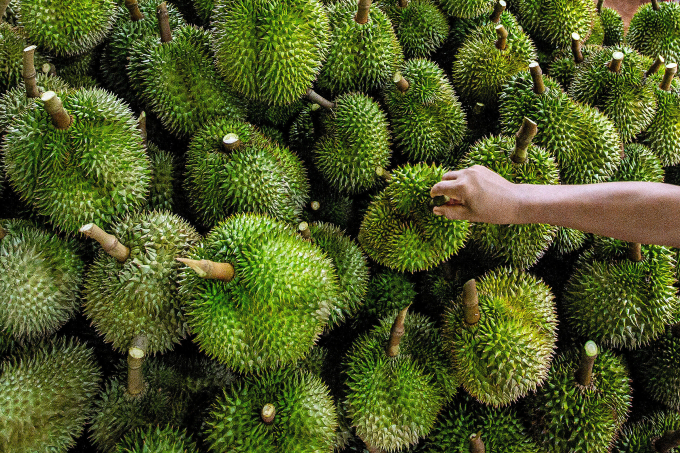
A worker piles freshly harvested durians at an orchard in Chumphon, Thailand, Sept. 18, 2023. Photo by Xinhua via AFP |
Facing mounting backlash, Pimrypie stressed that the livestream was meant to support durian growers and raise awareness of the sector’s difficulties, not to distort market pricing.
She noted that she had never organized such a large-scale campaign before and had absorbed personal losses exceeding 10 million baht from the sales.
“I do not want people to rely on me alone, but to recognize the value of Thai durian and support farmers together,” Pimrypie said, as quoted by the Bangkok Post. “In the past, durian may have been seen as a luxury fruit, but I want everyone to have fairer access to it.”
The Ministry of Commerce also responded quickly. Its deputy spokesman said the promotion was limited to “secondary-grade” fruits with visual imperfections.
Suphajee, who has faced calls to resign following the drama, distanced herself from the campaign, saying the ministry neither organizes nor endorses individual sales promotions and is responsible only for setting standards. She described the 100-baht price as a “sales-promotion technique” rather than an indication of value.
She added that market prices are still satisfactory, with export-grade A and B durians selling for about 135-150 baht per kilogram while lower-quality grade C and D fetch 90-100 baht and 70-80 baht, respectively.
A looming glut
Durian is one of Thailand’s most lucrative agricultural exports, with 2025 shipments exceeding 979,000 tonnes worth $4.37 billion and accounting for a large share of global durian trade, according to Bloomberg.
Drawn by strong prices in the late 2010s, growers in the country rapidly expanded cultivation, leaving Thailand with about 1.4 million rai (224,000 hectares) under durian in 2026, up 10% from last year.
This year’s surge in output is being compounded by global economic uncertainty that is making consumers more cautious, rising transport costs and extreme heat, which is expected to yield smaller, lower-grade fruits.
Roughly 30% of the harvest is consumed locally while the bulk is exported, leaving farmers vulnerable when overseas demand weakens and competition intensifies.
China, the largest market for durian, imported $7.5 billion worth of the fruit last year, with Thailand supplying about 941,000 tonnes valued at $4 billion while Vietnam shipped roughly 920,500 tonnes worth $3.4 billion, according to a March report by BMI cited by Bernama.
Vietnam, in particular, has rapidly expanded its foothold, capturing more than 40% of the market within just three years.
Malaysia, meanwhile, exported far smaller volumes at 3,064 tonnes worth $37.2 million but has built a reputation for premium-quality durians that command higher prices.
While prices of Thai export-grade durians are stable and the market has not collapsed, the sector is bracing for a major test in May, when peak harvest volumes are expected to arrive, several times higher than in April. If supply is not moved quickly, prices could plummet.
The commerce minister, for her part, has set out a strategy aimed at stabilizing prices and supporting growers by boosting domestic consumption and expanding overseas sales.
The plan includes expanding export routes, investing in storage and processing, and training farmers in live commerce and content creation to reduce reliance on middlemen.
“The proactive approach is intended to spread output ahead of time, reduce the risk of market congestion and help maintain price stability,” Suphajee said.