South Korea has proposed providing cash assistance of 100,000–600,000 won (US$65–390) per person to the bottom 70% of earners, or around 35.8 million people, to cushion the impact of surging fuel prices.
The amount each person received will depend on their income and where they live, The Korea Times reported.
Those living in the Seoul metropolitan area will receive the minimum 100,000 won while residents in regions facing population decline could get as much as 250,000 won.
Vulnerable groups will get more support, with single-parent households and families close to the poverty line slated for 450,000 won and basic livelihood recipients for 550,000 won. People living outside the capital region will receive an additional 50,000 won.
It is uncertain whether foreign nationals living in South Korea will be eligible. A similar scheme last year excluded most non-Koreans except for permanent residents holding F-5 visas, marriage migrants and those listed on a household registration with at least one Korean national, as reported by The Korea Herald.
|
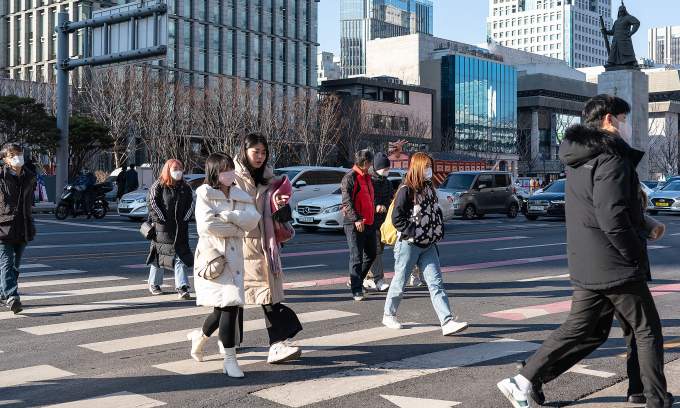
People cross the street at Gwanghwamun Square on Dec. 30, 2022, in Seoul, South Korea. Photo by Kichul Shin via Reuters |
The latest handout scheme, announced Tuesday as a key part of a 26.2 trillion won supplementary budget proposal, aimed at easing the cost-of-living pressures caused by surging oil prices amid the Middle East conflict. The proposal is subject to parliamentary approval.
Beyond the 4.8 trillion-won handout scheme, the budget also allocates 10.1 trillion won to measures responding to high oil prices, 2.8 trillion won in support for low-income households and young people, and 2.6 trillion won to help companies affected by the war, Reuters reported.
The spike in fuel prices has heightened both growth and inflation risks for Asia’s fourth-largest economy, which imports about 70% of its oil from the Middle East.
If passed, the extra budget would raise total government spending in 2026 to 752.1 trillion won, an 11.8% increase from last year, and add an estimated 0.2 percentage points to economic growth. The government had earlier planned a budget of 727.9 trillion won before the conflict erupted.