Rhe richest quintile of resident households recorded an average net wealth of S$5.26 million (US$4.16 million) in 2023, with property making up at least half of their assets, according to a Ministry of Finance study released on Monday.
By comparison, the other 80% of households together averaged a combined net wealth of about S$3.51 million, while the bottom 20% held just S$293,000.
The study defines net wealth as the difference between total assets and liabilities. Assets include property values, net Central Provident Fund balances and other financial assets like cash and investments. Liabilities are largely made up of mortgages and other debts.
CPF is Singapore’s mandatory social security scheme covering retirement, health care, and home ownership.
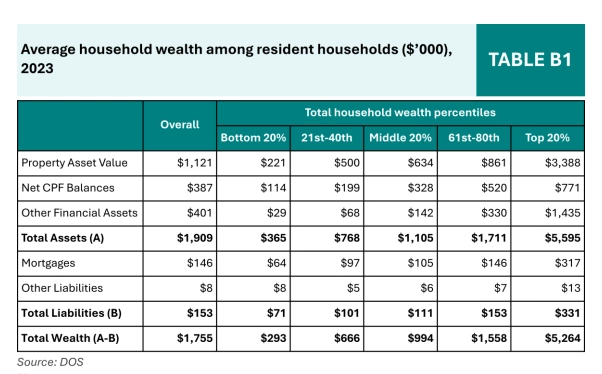
Households in the top 20% held close to S$5.6 million in assets on average, including S$3.34 million in property value, S$771,000 in net CPF balances and S$1.44 million in other assets.
Their liabilities averaged S$331,000, including S$317,000 in mortgages and S$13,000 in other liabilities.
In comparison, the average net wealth of the next wealthiest quintile was S$1.56 million while the middle 20% held S$994,000.
Net wealth fell further to S$666,000 for those in the 21st-40th percentiles and S$293,000 for the bottom 20%.
Taken together, the combined net wealth of the bottom 80% came to S$3.51 million, roughly two-thirds of the figure held by the richest quintile.
Across all households, average net wealth stood at S$1.75 million.
 |
|
Average household wealth among Singapore resident households (S$100,000 = US$79,000). Table from Singapore’s Ministry of Finance |
The numbers for the paper were calculated by the Singapore Department of Statistics based on the 2023 Household Expenditure Survey and available administrative data.
Home equity, measured as property value after deducting outstanding mortgages, accounts for more than half of average household wealth across all income quintiles in the city-state, the ministry said, as cited by The Straits Times.
This applies even to households in the lowest 20%, which contrasts with countries such as the U.K. and Australia, where comparable households typically record zero or negative housing equity.
CPF balances are another major component, making up about 22% of total household wealth for resident households in Singapore.
The Gini coefficient, a measure of inequality, is estimated at 0.55 in the city-state, broadly in line with countries like the U.K., Japan and Germany, where wealth Gini coefficients typically fall between 0.6-0.7, the study found.
However, wealth inequality, including in Singapore, is likely understated because assets held by the wealthiest households tend to be under-reported, the paper cautioned.
Separately, income inequality in Singapore declined to a record low of 0.379 in 2025, down from 0.437 in 2015.
Prime Minister Lawrence Wong said in a social media video responding to the paper that early signs of slowing social mobility are emerging as Singapore’s economy matures.
“Amid new headwinds, keeping Singapore moving in the right direction will require more effort and a willingness to adapt and do things differently,” he said, as quoted by The Business Times.
In the same video, he said the government was refreshing its approaches and renewing the social compact, Bloomberg quoted.
“Every Singaporean has real and meaningful opportunities to progress, and we continue to move forward together, even amidst a more challenging global environment.”