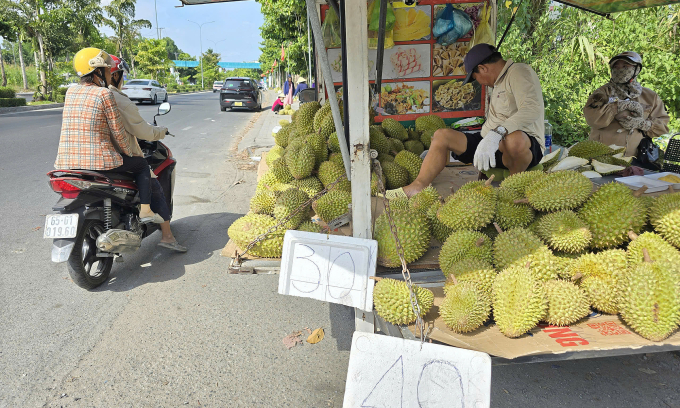
Now a month into the delta’s main harvest, Ri6 durian is selling at a multi-year low of VND15,000-30,000 per kilogram (US$0.8-1.1) at the farm gate, down 66% from January. Monthong durian has similarly fallen to VND70,000-80,000.
Many farmers in key growing areas such as Dong Thap Province and Can Tho City, are left with large quantities of fruits as few traders have come by, and are forced to sell them on the street or in rural markets.
 |
|
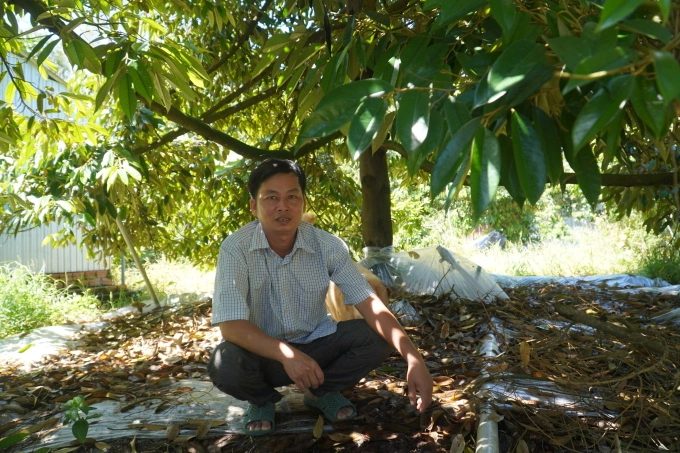
Farmer Nguyen Thanh Tam is facing losses due to declining durian prices. Photo by VnExpress/Ngoc Tai |
Nguyen Thanh Tam, owner of a 1.2-hectare Ri6 durian orchard in Dong Thap’s Tam Nong Commune, says he recently sold around 17 tons at VND29,000 per kilogram for grade A (highest quality) fruit and VND15,000 for grade B.
But around three tons spoiled earlier because traders delayed their purchases, he says.
He has incurred losses of VND180 million so far this season due to the low prices and a 10-20% increase in fertilizer and pesticide costs, he says.
“I have never seen durian this cheap. Farmers are really struggling.”
Nguyen Van Giang, who has a hectare under Monthong durian in Dong Thap’s Tan Phuoc Commune, says two weeks ago he signed a deal with a trader to sell his fruit at VND110,000 per kilogram.
But the trader postponed the purchase multiple times before cutting off all contact, he says.
After approaching several other merchants, who all declined to buy, he has been selling his fruit at the local market but still has around five tons unharvested. He says he barely made enough to cover his costs.
Dong Thap has around 32,000 hectares under durian and an annual output of over 500,000 tons, official data shows.
Can Tho has 13,000 ha and is expected to harvest 120,000 tons this year.
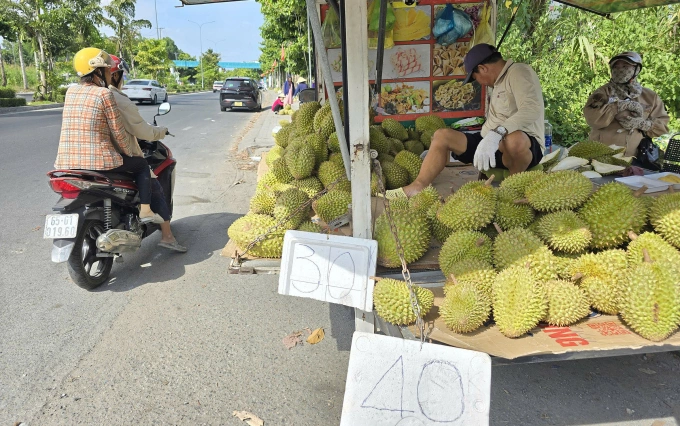
Phan Thi Dam, one of the many farmers seen selling durians on the road in Can Tho, says traders are not buying because of export difficulties.
 |
|
A roadside durian stall on Nguyen Van Cu Street in the Mekong Delta city of Can Tho. Photo by An Binh |
Dang Phuc Nguyen, general secretary of the Vietnam Fruit and Vegetable Association, says some durians exported to China were found to be contaminated with cadmium, a heavy metal.
While shipment samples are tested before reaching the border, substandard durians still slip past as traders often buy fruits from multiple orchards and mix them up at warehouses and packaging facilities, he explains.
“Many testing laboratories have become cautious after receiving warnings from Chinese authorities, with some even refusing to accept samples, causing export bottlenecks and sharp price declines.”
Thailand, a major rival durian exporter, is in its peak durian harvest season from April to June, flooding the market and pushing prices down across the region, he notes.
Over the long run, he suggests setting up laboratories in producing areas to test fruit earlier in the export chain—directly at orchards even before harvest.
“Thailand has licensed around 500 laboratories to support farmers and control quality directly at orchards.”
 |
|
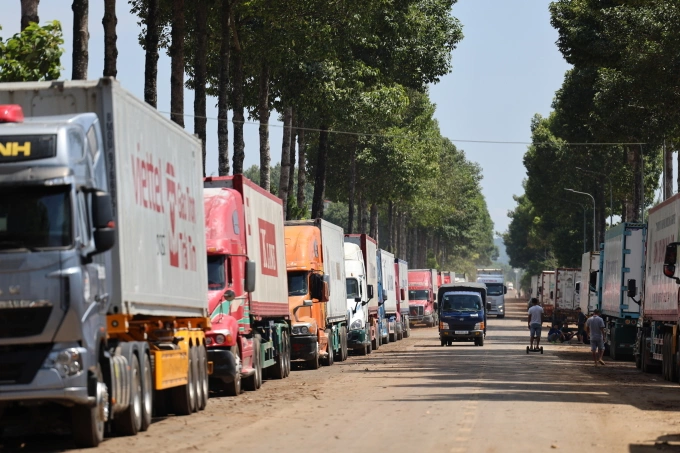
Durian containers pile up on a road in Dong Nai Province for sample tests, May 7, 2026. Photo by VnExpress/Phuoc Tuan |
Dr. Tran Huu Hiep, an economist, says the sharp decline in durian prices and export difficulties are also due to an unsustainable growth model that heavily depends on the Chinese market, rapid expansion of production area and slow adoption of quality control measures.
Over 150,000 ha were under the fruit in Vietnam last year, more than twice the figure targeted in 2030, according to the Plant Production and Protection Department.
But the use of fertilizers and pesticides is poorly controlled and agricultural standards are not being followed in many areas, according to Hiep.
As a result, Vietnamese durians have difficulty entering premium markets with strict import requirements, such as the EU, the U.S., Japan, and South Korea, he says.
“Exports require supply chain management, transparent data and clear traceability.”
The industry mainly competes through seasonal advantages and geographic proximity to China, rather than by having a strong brand or meeting internationally recognized standards, he says.
Therefore, it needs to invest heavily in deep processing and building a national brand, he says.
“This is not just an issue for the agricultural sector, but a matter of national competitiveness.”