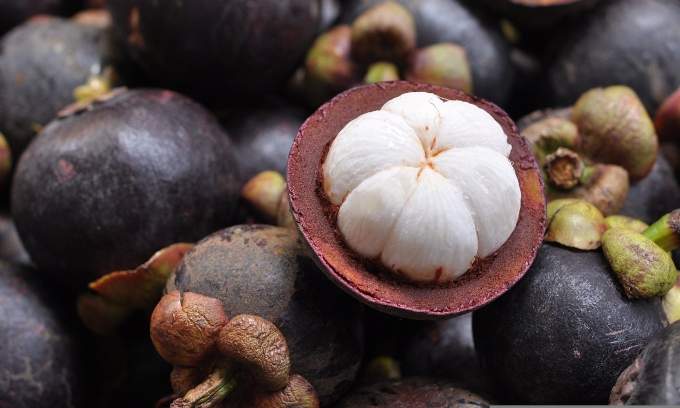
Locally grown Mesta mangosteens, or Japanese mangosteens, are now selling for about RM20 per kilogram while the well-known Musang King durian has dropped to as low as RM16.80 per kilogram, as reported by The Star.
“Varieties [of durian] such as D13 and Red Prawn are widely available currently, with prices as low as RM5 per fruit,” fruit seller Walter Chew told the Malaysian newspaper. “We are even offering buy-one-free-one promotions.”
Chew attributed the drop in durian prices to a surge in supply amid a “mini season,” which began about two weeks ago and features durians from several areas in Malaysia’s southernmost state of Johor.
Supply of local mangosteens, meanwhile, has been limited and unstable, he noted.
 |
|
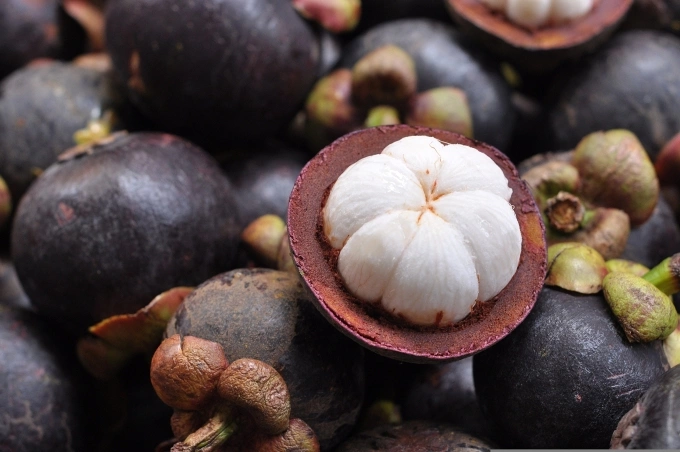
An opened mangosteen. Photo by Pixabay |
Another fruit seller, Yong Boon Sing, said most mangosteens now on the market are imported from Thailand and Indonesia.
Supply changes amid farming shift
Durian supply in Malaysia has been rising over the years as production grows along with the fruit’s contribution to the economy.
Exports of the fruit to China, the world’s largest durian market, reached $37.2 million in 2025, with Malaysian shipments seen as premium and commanding much higher prices than regional peers, averaging $12,138 per tonne compared with $4,239 for Thai and $3,739 for Vietnamese fruits, according to national news agency Bernama.
Durian has also driven tourism to the country as travelers are increasingly planning trips around harvest seasons and visiting orchards to sample different varieties and take part in experience-driven packages, according to a March report by BMI, a unit of Fitch Solutions.
Government data cited by The New York Times showed that durian plantations in Malaysia had expanded from over 163,000 acres in 2016 to more than 227,000 acres by 2024 while yields almost doubled to over 568,000 tonnes during the same period.
The surge in supply has weighed on prices. Musang King, which once sold for as much as RM100 per kilogram, has seen prices drop by about 80%.
 |
|
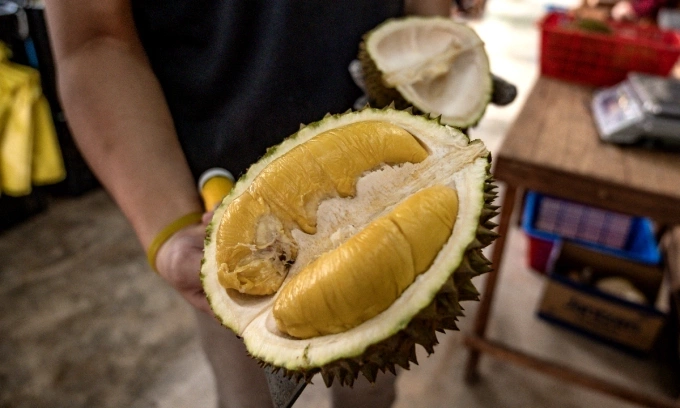
A worker shows a Musang King variety of durian at a shop in Kuala Lumpur, Malaysia, on July 8, 2020. Photo by AFP |
Farmers typically grow mangosteen alongside durian to add an additional source of income and create a more balanced farm ecosystem. As such, the “queen of fruits” has traditionally been available during durian season, with the two often eaten together as a classic combination, according to news website SAYS.
But Yong said many new durian orchard owners have chopped down mangosteen trees in recent years as their foliage can block sunlight and limit rain from reaching durian roots, leading to a decline in mangosteen production and, subsequently, a hike in prices.
Nor Sam Alwi, director-general of the Department of Agriculture, said last year that mangosteen production declined from 23,297 tonnes in 2020 to 22,073 tonnes in 2023.
She said the crop’s long juvenile phase, which takes more than six years to reach full production, has discouraged investment, particularly when compared with more profitable crops such as durian.
However, she noted that yields have also been affected by multiple factors, including weather shifts and increasing vulnerability to certain physiological disorders, and that preliminary data for 2024 pointed to a recovery in output.
Chin Nyuk Moy, president of the Kuala Lumpur Fruits Wholesalers’ Association, told The Star: “Some orchards in Raub still grow the Japan variety, but the days when mangosteens appeared during durian season are mostly over.”