 |
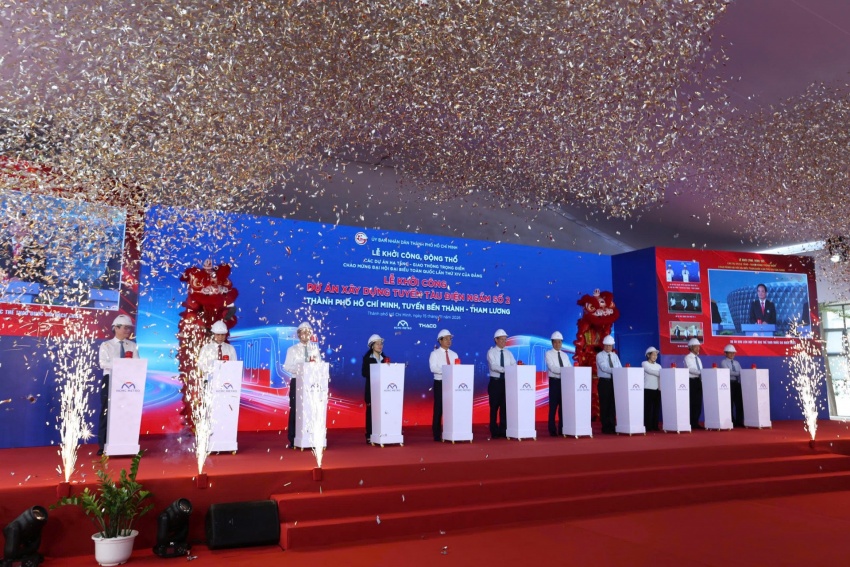
| Ho Chi Minh City commenced construction and held ground-breaking ceremonies for four key infrastructure and transport projects on January 15 |
Those are Metro Line No. 2 (Ben Thanh – Tham Luong), Rach Chiec National Sports Complex, Phu My 2 Bridge, and Can Gio Bridge.
Speaking at the ceremony, Nguyen Loc Ha, Standing Vice Chairman of Ho Chi Minh City People’s Committee, said that the commencement of the projects represents a concrete step towards realising the city’s development objectives.
“Ho Chi Minh City is facing a historic opportunity to evolve into a multi-centred mega-urban area, closely integrated with Binh Duong and Ba Ria-Vung Tau. This vision aims to create an urban structure comparable to major Asian metropolitan regions such as Bangkok or Seoul, with a population exceeding 14 million,” Ha said.
“A mega-urban scale requires infrastructure of commensurate capacity, developed one step ahead. This is an internal necessity and a political responsibility of the city toward the Southern Key Economic Region,” Ha added.
“Implementing General Secretary To Lam’s guidance on strategic infrastructure development, the city has prioritised several critical projects to address bottlenecks. Metro Line No. 2 will connect the city centre with the north-western corridor, while Phu My 2 Bridge and Can Gio Bridge will complete the southern transport network and strengthen connectivity to Long Thanh International Airport,” Ha added.
Rach Chiec National Sports Complex, with an investment exceeding VND145.6 trillion ($5.6 billion), is considered as a strategic project, positioning the cultural and sports industries as a new growth driver of the city’s economy.
The VND145.6 trillion ($5.6 billion) Rach Chiec National Sports Complex has been assigned to Vung Tau Sun Co., Ltd., a member of Sun Group, under the public-private partnership (PPP) model.
The project is planned over an area of more than 186 hectares in Binh Trung ward, with its core component being a central stadium with a seating capacity of up to 70,000.
The stadium will occupy 24ha and be the largest stadium ever built in Ho Chi Minh City, ranking among the most significant sports facilities in Southeast Asia and approaching the scale of iconic stadiums worldwide.
Beyond a single stadium, Rach Chiec is envisioned as a multi-functional sports, cultural, and service complex. The project will include a system of multipurpose indoor arenas and performance halls, a multidisciplinary sports centre, an aquatics centre, a tennis complex, and training and coaching facilities, as well as public parks and an extended central plaza seamlessly connecting the project’s various functions.
With an estimated construction timeline of approximately eight years, Rach Chiec National Sports Complex, once completed, will form a regional and national sports hub, creating high-quality open public spaces, and establishing Vietnam’s first advanced sports economy ecosystem. The project is expected to promote professional sports services and products while strengthening linkages between sports, culture, tourism, and education.
Metro Line No. 2 (Ben Thanh – Tham Luong) has a total investment of VND55.179 trillion ($2.1 billion) from the Ho Chi Minh City budget.
The line is one of the city’s most important radial corridors, connecting the central area with the north-western gateway across 11.3 km, including 9.3 km underground and 2 km elevated, with 10 underground stations, one elevated station, and one depot.
During the initial operating phase, the line will use three-car trains with a maximum speed of 110 kph, offering a capacity of approximately 14,400 passengers per hour. Upon full completion, six-car trains will be deployed, increasing capacity to more than 40,500 passengers per hour.
Metro Line No. 2 is designed to comply with European standards, employing advanced technologies, a 1,500V DC power supply system, regenerative energy recovery, and an integrated automated ticketing system across the network, supporting green and sustainable urban transport.
The Phu My 2 Bridge and Can Gio Bridge projects are being developed under the PPP model, with total investment values of approximately VND23.186 trillion ($891 million) and over VND 13.2 trillion ($507 million), respectively. These are strategic transport infrastructure projects that will contribute to completing Ho Chi Minh City’s external and inter-regional transport network. Both bridges are expected to be completed in 2029.
Phu My 2 Bridge will have a total length of 6.3 km with eight traffic lanes, connecting the southern part of Ho Chi Minh City with Dai Phuoc commune, Dong Nai province, and creating a new transport axis towards Long Thanh International Airport.
Can Gio Bridge, crossing the Soai Rap River, will have six traffic lanes and a total length of more than 6 km, replacing the Binh Khanh ferry and ending the long-standing “transport island” status of Can Gio district.
The project will open up new development space towards the sea, creating momentum for ecotourism, the marine economy, and coastal urban development, while ensuring a balanced approach between socioeconomic growth and the conservation of the Can Gio Mangrove Biosphere Reserve.
Both bridges have been assigned to Masterise Group as the investor under the PPP framework, with completion targeted for 2029.
 |
Ho Chi Minh City’s industrial parks top $5.3 billion investment in 2025
Despite a challenging global investment climate, Ho Chi Minh City’s export processing and industrial zones continued to attract solid capital inflows in 2025, while demand for ready-built facilities surged as investors sought speed and flexibility. |
 |
Major transport PPP projects open 2026 with strong investor interest
A series of sizeable transport projects under the public private partnership (PPP) model across Ho Chi Minh City and southern region have been launched, drawing strong investor interest ahead of upcoming bidding rounds. |