 |
How can the Asia-Pacific wind industry move from scale growth to high-quality growth, and how do you define Goldwind’s long-term success in the region?
That’s a crucial question. The wind industry in Asia-Pacific has been developing for many years, and as a reliable global strategic partner in clean energy, we’ve become much clearer about one thing: speed of growth is not the real goal – quality is important for long-term survival and success. Three key shifts are needed.
First, move from generic products to scenario-based solutions. Asia-Pacific is not one market. The Philippines has super typhoons, India has extreme heat, Thailand needs low-wind-speed solutions, and Australia has high grid support requirements. Competing on turbine size or capacity is not enough. High-quality growth means providing the right technical solution for each project’s conditions and customer needs.
Second, move from equipment delivery to full lifecycle asset management. High-quality growth means helping customers secure long-term asset performance for 20 years or more. That means getting involved early, from wind resource assessment to quality control, then using digital tools for proactive maintenance, and later helping customers upgrade existing assets. One repowering project in China replaced 155 old turbines with 33 large machines, reducing turbine positions by 78 per cent while increasing power generation by 2.5 times.
Third, move from point-to-point competition to ecosystem co-building. The future is not just about putting up more turbines. It’s about building a complete value system across time, geography, and capabilities – including full lifecycle coverage, global capability with local adaptation, and integrated wind-plus-storage and zero-carbon solutions.
Based on this, I define Goldwind’s long-term success in Asia-Pacific through three objectives. First, we aim to be a long-term strategic partner for local developers, helping them maximise asset returns while reducing energy costs and operational risks. Second, we are committed to localisation – building local ecosystems including talent, supply chains, service networks, and technology expertise. Third, we do not measure success by short-term installation rankings alone, but by the long-term reliability of the assets we support, the value we create for local industry, and the confidence of customers who continue to choose Goldwind as a trusted partner.
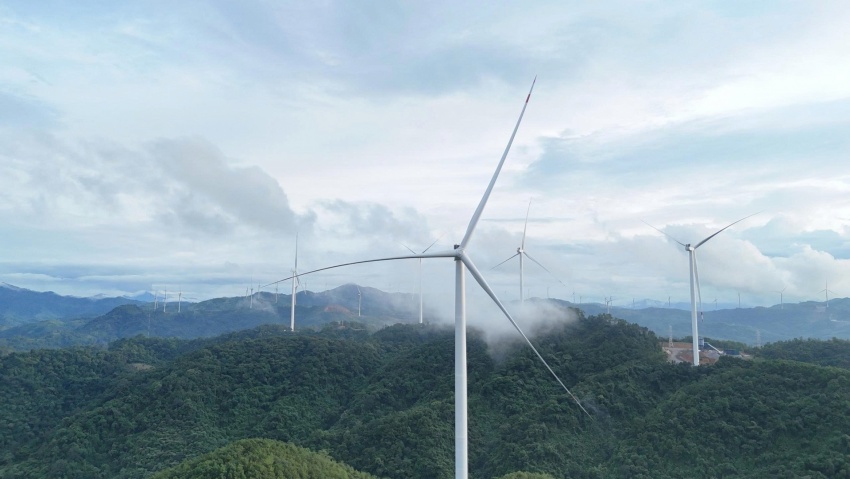 |
| The Vietnam Tan Hop project is equipped with Goldwind turbines |
What progress has Goldwind made in localisation across Asia-Pacific, particularly in Vietnam, in terms of talent, supply chain, and partnerships?
The core idea behind Goldwind’s localisation in Asia-Pacific is ‘global capability, local adaptation’. We are not just copying our China experience – we are combining global technical capabilities with the realities of each local market.
Taking Vietnam as an example, our localisation strategy is built around talent development, supply chain integration, and long-term partnerships.
Goldwind has established offices in Hanoi and Ho Chi Minh City, alongside a remote operations centre, regional warehouses, and a dedicated training centre. Local employees now account for 75 per cent of our operations team across Vietnam and Laos. Our service team has achieved an average repair response time of just seven hours, while technical availability reached 99.65 per cent in 2025.
One important lesson is that localisation cannot stop at hiring local employees. It must be supported by systematic training and empowerment, enabling local engineers to independently manage the entire process from monitoring to maintenance. Our training centre plays a key role in strengthening technical capabilities and safety standards.
The same philosophy applies to supply chain development. In Vietnam, we have achieved 100 per cent localisation for towers and consumables, while more than 90 per cent of tools are sourced locally. We also help local companies meet international standards by deploying quality engineers to provide process guidance and system audits.
On partnerships, Goldwind has established a deep relationship with GG Power in Vietnam, supporting equipment supply and the development of an energy storage production line. Similar initiatives are under way across the region. In Thailand, the first foundation pour has recently been completed for our pre-assembled hybrid tower project.
Looking back, our localisation experience can be summarised simply: invest in people, help suppliers build capabilities, and create genuine win-win partnerships. Only when local partners succeed alongside us can we build a strong foundation for long-term development.
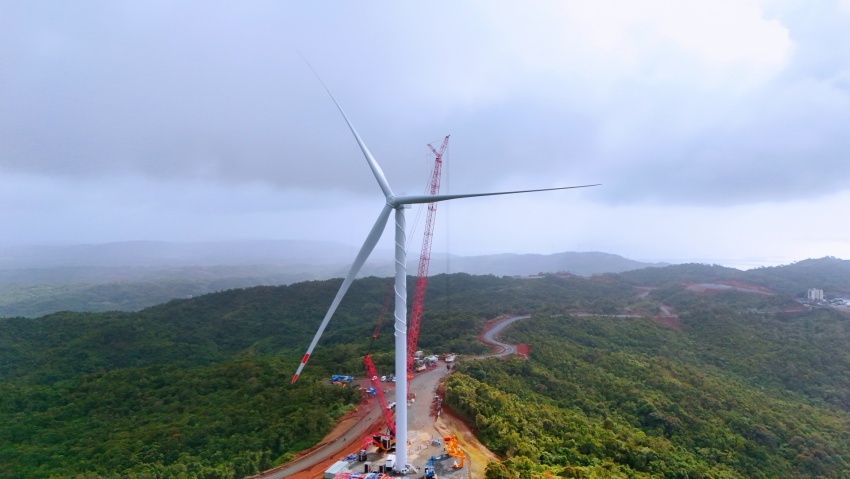 |
| Philippines Kalayaan 2 is equipped with Goldwind turbines |
How is Goldwind differentiating itself in energy storage, O&M, and hybrid towers as it transforms into a comprehensive clean energy solutions provider?
Goldwind has evolved from a wind turbine manufacturer into a comprehensive clean energy solutions provider, underpinned by several differentiated capabilities.
On energy storage, Goldwind’s annual production capacity exceeds 10 GWh, with more than 15 GWh already operating globally. What differentiates us is the integration of wind power and storage through grid-forming technologies. A good example is the Moorabool project in Australia, where we deployed an integrated wind-plus-storage solution capable of actively supporting grid frequency and voltage, significantly improving stability in weak-grid environments. In Vietnam, we are also working with GG Power to develop a local energy storage manufacturing base.
On operations and maintenance, we see O&M not as reactive repair work, but as a way of creating long-term value for customers. That process begins before a project is commissioned, through precise wind resource assessment and rigorous quality control.
During operation, we use AI to predict potential faults 30 to 60 days in advance. At our L3 unmanned wind farm in Ningxia, China, more than 300 turbines are monitored remotely, reducing inspection hours by over 3,000 hours and improving labour efficiency by 27 per cent. Beyond the operational phase, we also support customers through repowering projects and asset reuse.
Beyond energy storage and O&M, Goldwind continues to invest in hybrid tower technologies, green energy chemistry, and zero-carbon industrial park solutions.
Goldwind’s differentiation can be summarised in three dimensions: all scenarios, all value chain, and all lifecycle. Whether onshore or offshore wind, storage integration, new developments, or asset repowering, our goal is to provide integrated solutions spanning planning, design, customisation, intelligent O&M, and asset optimisation. Throughout that journey, our focus remains on delivering reliability while supporting the long-term development of local energy ecosystems.
Source:vir.com.vn