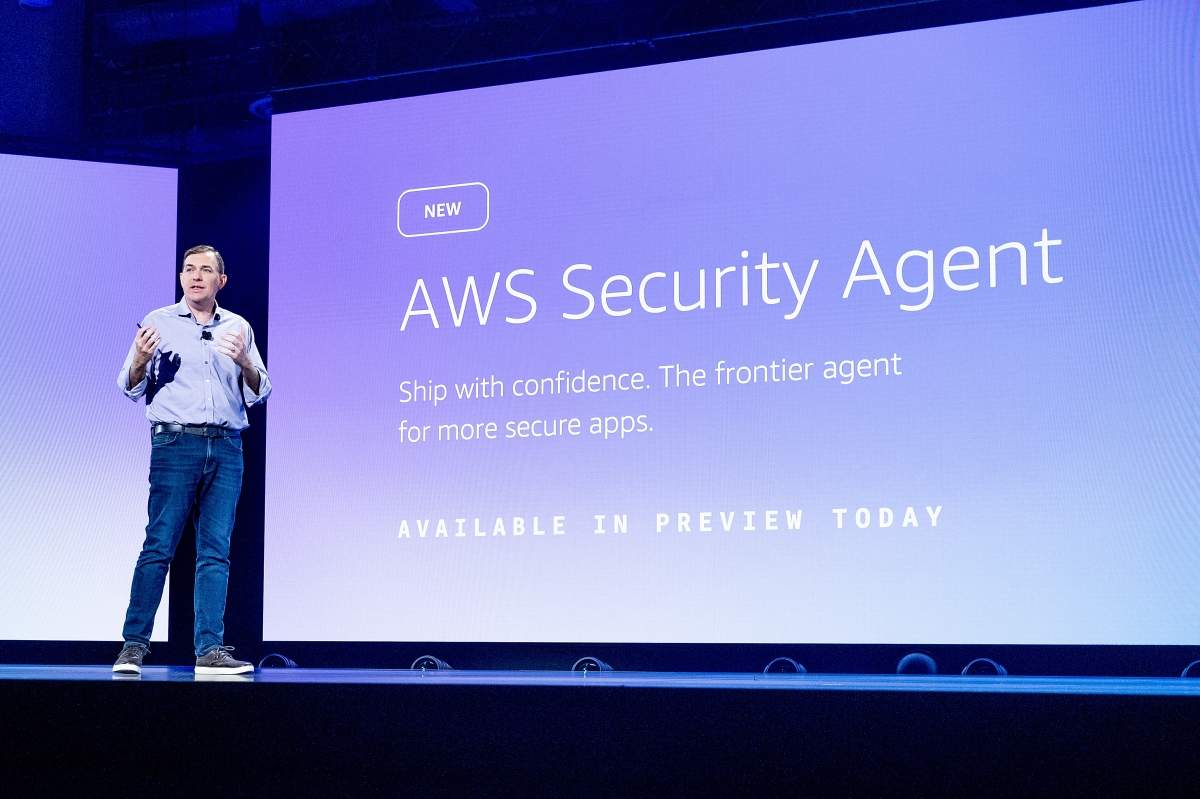
The five-day event, running from December 1-5, has drawn over 60,000 visits in person and nearly two million viewers online. This strong turnout reflects the growing interest in AI technology across industries.
Strong growth momentum
During his keynote address on December 2, AWS CEO Matt Garman shared impressive growth figures. The company has grown into a $132 billion business, accelerating at 20 per cent on-year. In the past year alone, AWS added $22 billion in revenue. That single-year growth exceeds the annual revenue of more than half of the Fortune 500 companies.
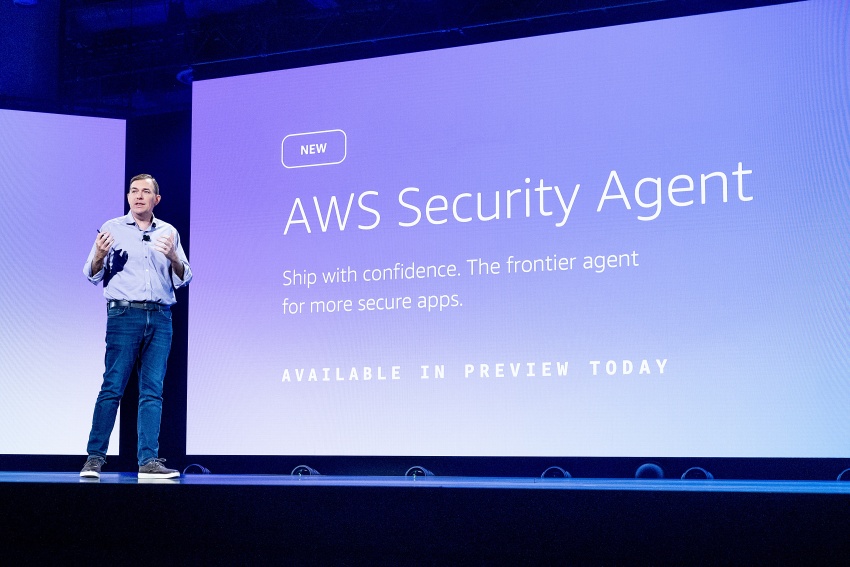 |
| AWS CEO Matt Garman. Photo: AWS |
The growth spans across AWS’s entire product portfolio. Amazon S3, one of the company’s foundational storage services, now holds more than 500 trillion objects and hundreds of exabytes of data. The service handles an average of over 200 million requests every second, every day.
AWS has also seen strong adoption of its custom-designed processors. For the third consecutive year, more than half of the new CPU capacity added to the AWS Cloud comes from its AWS Graviton 5 processors. Meanwhile, Amazon Bedrock, the company’s generative AI service, now powers AI inference for more than 100,000 companies worldwide.
Garman emphasised AWS’s leadership in AI infrastructure. The company operates the largest and most widely deployed AI cloud infrastructure globally, with a network spanning 38 regions and 120 availability zones. AWS has already announced plans for three additional regions.
“We have millions of customers running every imaginable use case, the largest enterprises in the world, across every single industry and vertical, running their businesses on us,” Garman said. He noted that AWS has transformed industries including financial services, healthcare, media, entertainment, telecommunications, and government agencies around the world.
Startups are also flocking to the platform. More than half of all startups funded by tier-one venture capital firms worldwide now run on AWS. “It’s incredibly amazing, and I’m personally amazed at what these founders are inventing,” Garman added.
Breakthrough AI innovations
At this year’s event, AWS also unveiled several groundbreaking innovations designed to help organizsations thrive in the AI era. The announcements include frontier agents that can work autonomously for days, an expansion of the Amazon Nova model family, and the availability of Trainium3 UltraServers.
AWS is expanding its Nova portfolio with four new models that deliver industry-leading price-performance across reasoning, multimodal processing, conversational AI, code generation, and agentic tasks.
The company also unveiled three “frontier agents” that represent a significant advancement in AI capabilities. The Kiro autonomous agent acts as a virtual developer for teams. AWS Security Agent brings security consulting and penetration testing directly to developers. And AWS DevOps Agent functions as an on-call operational team. These agents work as extensions of software development teams and represent a major step forward in what AI agents can accomplish.
AWS AI Factories is a new service that helps transform customers’ existing infrastructure into high-performance AI environments. The company also launched new Amazon EC2 instances powered by NVIDIA GPUs.
 |
| Photo: AWS |
For legacy companies, AWS Transform has been enhanced to be able to modernize legacy code and applications up to five times faster. The service is adding new agentic AI capabilities that help companies modernize any code and application.
Amazon Bedrock AgentCore, which helps developers build production-ready AI agents, was also further enhanced with new policy, evaluation, and memory capabilities that will further speed up deployment of AI agents for businesses.
Finally, AWS Lambda durable functions enable reliable multistep applications and AI workflows. This new capability helps developers build more complex and reliable applications.
Enhanced storage and database services
Besides GenAI, AWS also showcased improvements and enhancements in its ongoing powerhouse across the rest of its technology stack. The company unveiled its latest Trainium3 UltraServers, which delivers up to 4.4 times more compute performance than the previous generation. This enables customers to train and deploy AI models faster and at lower cost.
Amazon S3 Vectors is also now generally available with significant scale and performance improvements. This enables AI systems to store and query vectors natively in Amazon S3 for semantic search and context understanding.
AWS accelerates Amazon S3 Batch Operations for large jobs to run up to 10 times faster. This delivers the speed that customers demand for large-scale data processing and time-sensitive data migrations. At the same time, AWS is expanding Amazon S3 Access Points to support Amazon FSx for NetApp ONTAP. This allows customers to access files stored in FSx as if the data were in Amazon S3.
AWS also recognised that there continued to be ways to help its customers drive down database costs, and so also announced Savings Plans, which enable customers to reduce their database costs by up to 35 per cent.
The company has unified security, operations, and compliance data in CloudWatch. It also eliminates local storage provisioning for EMR Serverless.
AWS Security Hub, now generally available, helps centralise and deliver near real-time threats so security teams can act faster to mitigate threats.
Coming soon, AWS databases including Amazon Aurora and Amazon DynamoDB will be available as native integrations on Vercel Marketplace and v0. Developers will be able to connect to Aurora PostgreSQL, Aurora DSQL, or DynamoDB in seconds from their Vercel dashboard or in v0 prompts. This will accelerate the velocity of building new applications.
Strategic partnerships expand capabilities
AWS announced several major partnerships at the event. BlackRock and AWS reveal a strategic collaboration to bring BlackRock Aladdin clients more cloud hosting options.
“Our Aladdin clients are seeking open, flexible platforms that can adapt to their operating models and scale with their ambitions,” said Sudhir Nair, senior managing director and global head of Aladdin at BlackRock. “By expanding Aladdin to AWS, we are giving clients more choice in where and how they deploy their technology ecosystem.”
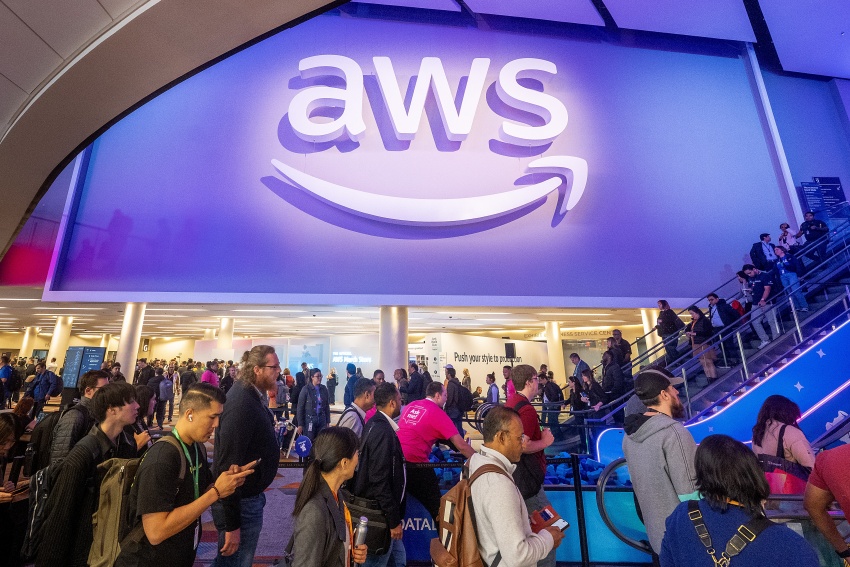 |
| Thousands of people joined AWS re:Invent. Photo: AWS |
Nissan Motor Co. announced the Nissan Scalable Open Software Platform, a new cloud-based foundation powered by AWS that accelerates software-defined vehicle development.
Visa and AWS announced a collaboration. Visa will list the Visa Intelligence Commerce platform in AWS Marketplace, helping businesses and developers connect seamlessly to a growing ecosystem of agentic commerce providers for secure payment experiences.
Sony Group announced a partnership with AWS to accelerate its enterprise use of AI and build an engagement platform that creates deeper connections between fans and content creators. This partnership enables Sony to deliver kando, a Japanese term for deep emotional connection or experiences, across its diverse business portfolio including electronics, gaming, music, movies, and anime.
Adobe and Amazon are deepening their collaboration across product innovation, new business models, and enhanced customer engagement to accelerate AI transformation.
WRITER, a leader in agentic AI, is natively integrating with Amazon Bedrock to give customers flexibility in deploying various leading models, including custom-trained models built by enterprises, directly into WRITER’s enterprise agent platform.
Zendesk announced a strategic collaboration agreement with AWS focusing on integrating Amazon Connect voice capabilities, conversational analytics, and sentiment analysis with Zendesk Contact Centre.