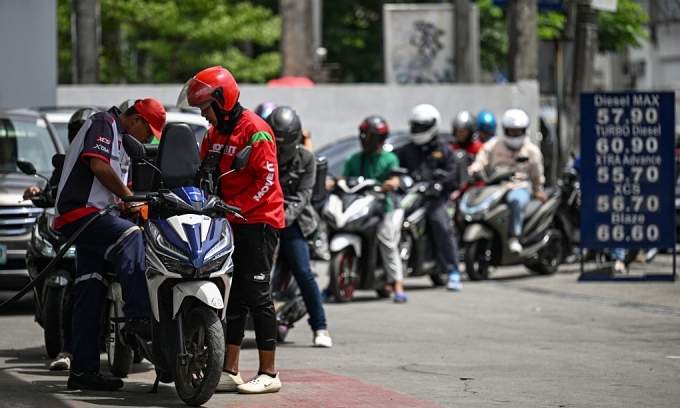

Motorists queue at a gas station amid rising petrol prices in Quezon City, Metro Manila, the Philippines, on March 9, 2026. Photo by AFP
Southeast Asian nations hit by soaring fuel and food prices caused by the Middle East war are weighing solutions that include setting up a regional oil reserve, Philippine President Ferdinand Marcos said.
Leaders of the Association of Southeast Asian Nations (ASEAN) called for the opening of the Strait of Hormuz, while also debating a series of ambitious projects aimed at stemming the effects of the next global crisis.
Marcos said Friday all member states agreed on the need to act with speed, speaking to reporters hours after an overnight flare-up in the critical waterway.
“We needed it yesterday, if not sooner,” Marcos said of the raft of energy proposals. “That’s the way we are approaching the problem.”
A closing statement called for the swift ratification of the bloc’s Framework Agreement on Petroleum Security, a fuel-sharing scheme aimed at ensuring energy stability.
Members also signed off on a push for an ASEAN Power Grid, aimed at connecting national electricity networks to enable cross-border power trading.
Marcos said the idea was agreed unanimously, but conceded the devil was in the details.
“Let’s talk about the fuel reserve. Is it going to be in one single place? Is it going to be scattered throughout the whole of ASEAN?” he said.
“Some countries have a surplus of a certain kind of fuel. Other people have a shortage,” Marcos said. “We’re trying to balance that out.”
Singapore Prime Minister Lawrence Wong expressed support during a morning session for both the power grid and the fuel reserve concept, while warning that the effects of the strait’s closure would linger long after it was reopened.
“It will take time — at least months — for damaged infrastructure to be repaired, for the strait to be demined, and for goods to flow through,” he told ASEAN leaders.