Vietnamese family-owned enterprises are entering a defining moment as their founders prepare to hand over the reins to the next-generation amid ambitious expansion plans and an evolving macroeconomic landscape.
This major generational transition comes at a time when the Vietnam’s policy landscape is shifting in favour of private sector development.
Under Resolution 68-NQ/TW, the government has increasingly prioritised private enterprises as key drivers of national economic growth. Furthermore, ongoing capital market reforms aimed at enhancing transparency, improving corporate governance, and accelerating a potential market upgrade are opening new funding channels.
To address these shifting dynamics, business leaders and next-generation executives recently gathered at a seminar co-hosted by Standard Chartered and PwC Vietnam on June 30 to explore how Vietnam family businesses can turn succession into a strategic advantage.
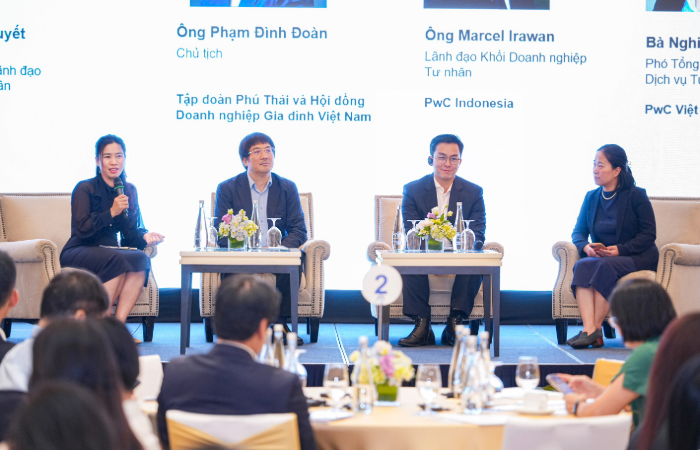 |
| Luong Thi Anh Tuyet, partner and private services leader at PwC Vietnam, takes the mic |
Data from the PwC Family Business Survey 2025 highlights a striking duality within the local market. While Vietnamese family firms are among the most growth-oriented globally, with nearly one-third pursuing aggressive expansion, this commercial ambition is rarely matched by formal corporate governance structures.
The survey reveals that internal misalignment remains a significant risk, primarily because very few local organisations have established formal mechanisms to manage generational transitions.
For instance, a mere 6 per cent of domestic family firms possess a family constitution, compared to a global average of 26 per cent, and only 22 per cent have formal shareholder agreements in place.
Additionally, 47 per cent of respondents indicate that their board of directors consists entirely of family members, often leading to a lack of diverse outside expertise within their top leadership ranks.
Bridging these structural gaps is essential for long-term commercial survival, particularly as digital disruption accelerates.
PwC’s survey notes that 73 per cent of next-generation leaders view generative AI as a powerful force for transformation, yet many question their organisation’s immediate readiness to capitalise on it.
Luong Thi Anh Tuyet, partner and private services leader at PwC Vietnam, emphasised that succession planning must evolve to meet these modern technological and structural demands.
“Succession is no longer simply about inheritance, it has become a dual-track journey: strengthening governance foundations while developing the next generation into capable and resilient leaders,” she stated.
This view was reinforced by Marcel Irawan, private leader at PwC Indonesia, who highlighted that passing the baton requires comprehensive preparation ahead of time.
“Across Asia, we see that succession succeeds not simply through transferring ownership, but through deliberately preparing three dimensions in parallel: values, wealth and leadership,” he said.
Ultimately, by establishing robust family governance early, aligning across generational divides, and embracing forward-looking leadership, Vietnamese family enterprises have a unique opportunity to turn a complex transition into a powerful catalyst for future transformation.
 |
PwC: Family businesses in Vietnam need to transform to build trust
Family businesses not only need to make transformative changes to build trust, they have also got to make their efforts visible and communicate them clearly to their stakeholders, according to the Family Business Survey 2023 – Transform to Build Trust by PwC Vietnam. |
 |
Navigating challenges and embracing succession: Insights for Vietnamese family businesses
Vietnam’s family businesses should prioritise the paramount importance of a well-crafted succession plan to secure their long-term success and effectively pass on leadership to future generations. |
 |
PwC 2025 Family Business Survey: navigating a new era of agility and purpose
PwC Vietnam has announced the launch of its 12th Family Business Survey, part of PwC’s global study that gathered insights from 1,325 family businesses across 62 territories, including 32 from Vietnam. |
Sourcevir.com.vn