 |
| George Chia, sales director for ASEAN region at ADI |
Speaking to the media on July 21 in Hanoi, Chia said Vietnam has emerged as one of the most advanced electric vehicle (EV) markets in Southeast Asia, not only because of rising EV adoption but also because domestic companies are increasingly developing and designing automotive technologies.
“I would say Vietnam is doing very well. In many other ASEAN countries, the focus is still mainly on EV consumption through imports or local assembly. However, when it comes to developing and designing automotive technologies, I have not seen the same level of activity elsewhere,” he said.
He attributed the momentum to a combination of supportive government policies, a growing technology ecosystem, and the presence of a strong domestic EV manufacturer that is accelerating innovation.
“Vietnam has a strong government commitment to technology development and innovation. At the same time, I see a vibrant startup ecosystem and many Vietnamese engineers returning from overseas to build technology companies. That combination creates strong momentum,” he said.
Chia said one of the biggest technology shifts in the automotive industry is the transition towards software-defined vehicles (SDVs), in which software increasingly controls vehicle functions and enables continuous upgrades throughout a vehicle’s lifetime.
Modern vehicles are evolving into high-performance computing platforms equipped with multiple cameras, digital displays, advanced driver assistance systems, premium audio systems, and increasingly sophisticated connectivity.
As vehicle electronics become more complex, manufacturers are moving away from traditional domain-based electronic architectures, where each function has its own controller, towards zonal architectures managed by centralised computing systems.
The new approach reduces wiring, lowers vehicle weight, improves manufacturing efficiency, and enables software updates to introduce new features after vehicles have been sold.
“The amount of data inside vehicles is increasing rapidly. Industry experts expect the volume of data processed in each vehicle to grow from around 20GB today to more than 200GB over the next decade,” he said.
Rather than developing central computing systems themselves, ADI focuses on the technologies that connect cameras, sensors, displays, speakers, and other electronic systems throughout the vehicle.
“You can think of our technology as the veins and blood vessels in the human body. The central computer may be the brain, but without the network connecting everything together, the brain cannot communicate with the rest of the body,” Chia said.
The company highlighted three automotive connectivity technologies supporting SDV architectures:
- GMSL (Gigabit Multimedia Serial Link), which enables high-speed, low-latency transmission between cameras, displays, and central processors for ADAS and infotainment systems;
- A2B (Automotive Audio Bus), which simplifies vehicle audio networks by carrying audio, control signals, and power over a single cable; and
- E2B (Ethernet to the Edge Bus), designed to connect sensors and actuators within zonal vehicle architectures.
According to Chia, GMSL technology has been deployed for more than two decades, with over one billion integrated circuits shipped globally. He confirmed that VinFast is among the automotive manufacturers already using ADI’s GMSL technology.
Looking ahead, Chia said Vietnam’s EV market is likely to be shaped by two parallel trends: improving user convenience and strengthening local technology capabilities.
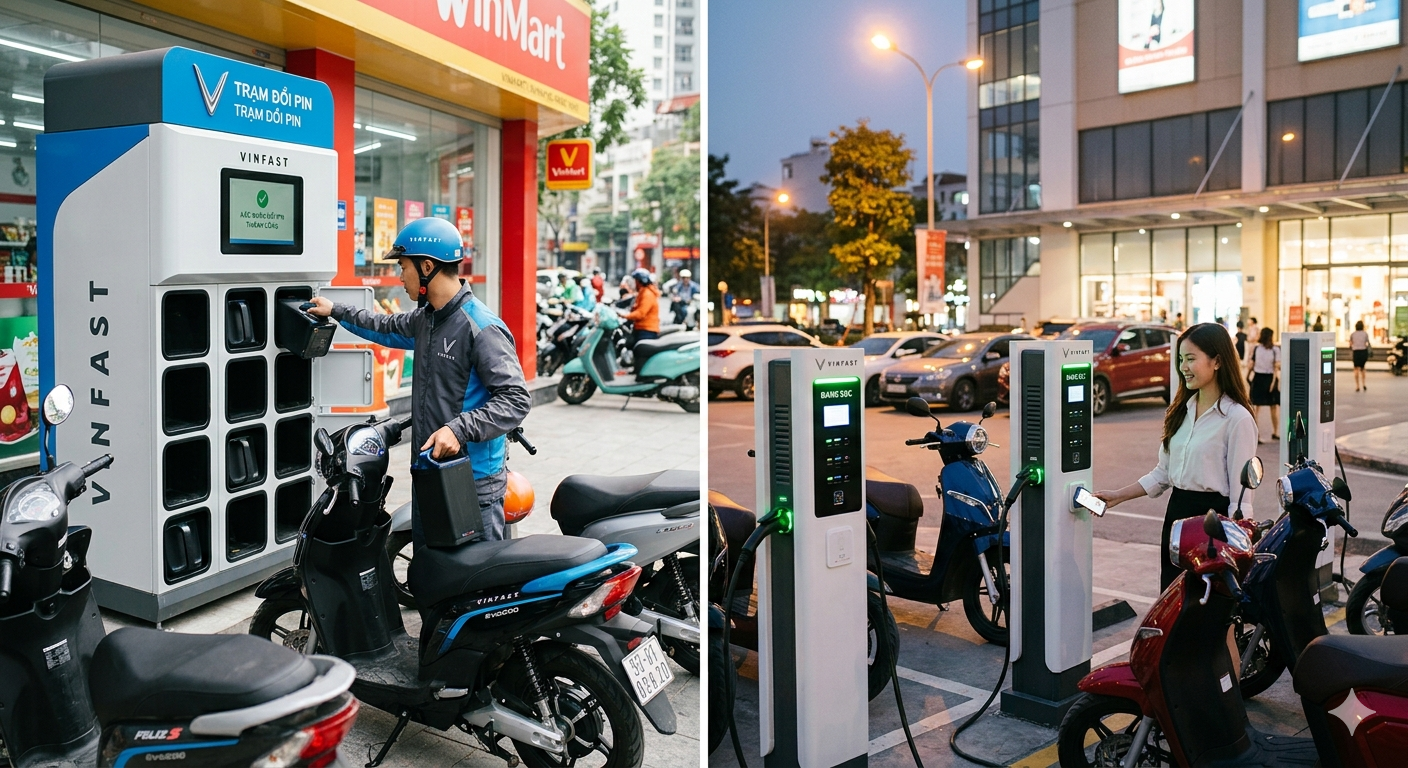
On the consumer side, expanding charging infrastructure for electric cars and battery-swapping networks for electric motorcycles will remain essential to accelerate adoption.
“Convenience is one of the most important factors in encouraging consumers to adopt EVs. Once that foundation is in place, consumers will naturally begin to expect higher levels of comfort and premium experiences inside the vehicle,” he said.
At the industry level, Chia believes Vietnam’s biggest long-term opportunity lies in developing more domestic engineering and design capabilities. He noted that most Tier-1 automotive suppliers operating in Vietnam remain foreign companies, while local manufacturers still rely heavily on externally developed modules and technologies.
“The opportunity is how Vietnamese companies can gradually build their own engineering and design capabilities instead of only purchasing complete modules. In the long run, design capabilities create much higher value than manufacturing alone,” he said.
Developing proprietary technologies and intellectual property would enable Vietnamese companies to move further up the automotive value chain, he added, although he acknowledged the transition would take time.
Chia also identified English-language proficiency as an area that could further strengthen Vietnam’s technology sector. “Having stronger English skills allows engineers to access technical documentation more quickly, collaborate internationally, and absorb new technologies faster,” he said.
Despite that challenge, Chia said Vietnam currently holds a strong position within Southeast Asia’s automotive technology landscape because of the combination of government support, domestic industry leadership, and an increasingly capable engineering workforce.
 |
VinFast deliveres over 58,000 EVs globally in Q1
VinFast delivered 58,577 electric vehicles globally in the first quarter, a 61 per cent increase on-year. |
 |
VCCI agrees with proposal to extend tax incentives for EVs
The Vietnam Chamber of Commerce and Industry agrees with the Ministry of Finance’s proposal to extend the special consumption tax on motor vehicles under 24 seats powered by batteries. |
 |
V-Green, EVNHANOI to install 10,000 EV battery swapping cabinets in Hanoi
V-Green Global Charging Station Development JSC and Hanoi Power Corporation have signed an agreement to deploy up to 10,000 electric motorbike battery swapping cabinets across the capital. |
Sourcevir.com.vn