The group, which was founded in 1987, has invested SGD10 million (US$7.8 million) into a new headquarters in the city-state as part of its expansion strategy. The facility brings its corporate office and central kitchen together at a single location spanning more than 8,300 square meters, nearly twice the size of its former premises.
Jumbo’s group CEO and executive chairman Ang Kiam Meng told The Business Times the move, fully funded by internal funds, was needed to future-proof the company as its operations had begun to outgrow its previous facilities.
“We have been searching for a building like this for a long time – one that can showcase all of Jumbo’s brands and capabilities under one roof,” Ang said.
Jumbo began relocating to the new headquarters in May 2025. The central kitchen is expected to be fully operational by the end of June.
 |
|
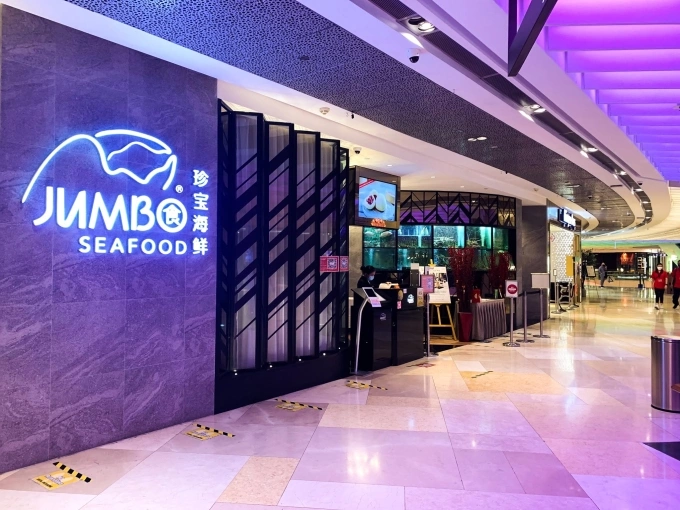
A Jumbo Seafood restaurant in Singapore. Photo via Facebook/Jumbo Group Singapore |
The group now operates 13 food and beverage brands with over 20 restaurants in Singapore and other countries. Its dining concepts include flagship brand, Jumbo Seafood, hawker brands Ng Ah Sio Bak Kut Teh and Kok Kee Wonton Noodle, as well as foreign brands such as Tsui Wah.
Heavy investment in the new headquarters, along with the opening of new outlets, pushed up operating expenses in the group’s first half ended March 31, 2026. As a result, net profit fell 22.3% to SGD6.2 million, even as revenue rose 7.9% to SGD105.1 million, according to a company filing.
The group will also have to close its flagship restaurant at East Coast Seafood Centre when its lease expires in September this year, ending nearly four decades of operations at the site, which contributes around 14% of its revenue, according to Channel News Asia.
Ang, however, said he is confident the company’s bottom line will improve in the next financial year as these investments begin to bear fruit “for 2027 and beyond.”
The group plans to concentrate on opening more Jumbo Seafood restaurants in Shanghai, a city Ang sees as generally more receptive to foreign concepts.
It now has nine Jumbo Seafood restaurants in China across seven cities, including three in Shanghai, as well as two Ng Ah Sio Bak Kut Teh outlets in Sanya. China operations account for 10% of group revenue, with Singapore contributing the rest.
Jumbo may also consider closing underperforming restaurants China as their leases expire and redirect resources to Shanghai instead.
“Shanghai is huge, cosmopolitan and very vibrant. There’s good spending power. The people there are very open to new ideas,” he said.
Ang noted that Jumbo previously tried to build a presence in too many Chinese cities, a strategy that backfired. The group has closed four outlets in recent years, including two Jumbo Seafood restaurants.
“Spreading our resources so thinly is not advisable especially for China, which is so diverse in culture and taste across cities,” Ang said. “So with this move to focus (on Shanghai), we’re very optimistic about our prospects in China.”
In Southeast Asia, Jumbo will open its first Jumbo Seafood restaurant in Indonesia’s Jakarta in July. The group is also looking for a local partner to reopen its Jumbo Seafood restaurant in HCMC, Vietnam, though Ang declined to provide a timeline in his interview with The Business Times. Jumbo also operates food and beverage outlets in South Korea, Cambodia, Thailand and Japan.
While Jumbo Seafood remains the group’s cash cow, Ang has continued to develop new revenue streams and dining concepts to diversify the business.
One area is institutional catering, where Jumbo aims to supply meals to hospitals, hotels, school hostels and staff canteens in Singapore.
To support the expansion, the group has built a dedicated catering kitchen at its new headquarters and incorporated a new subsidiary, Jumbo Catering Services, in December 2025.
Source:e.vnexpress.net